Donald Maclean

British Foreign Policy Since Suez 1956-1968 is an interesting book quite apart from its contents. It’s interesting because the author, Donald Maclean, was a British civil servant who spied for Russia from the 1930s until 1951.

Maclean wrote the book in 1970 when he was living in Moscow. Hodder and Stoughton published the book in the UK with Foreign Office approval.

I bought a second-hand copy after reading about it in Roland Philipps biography A Spy Named Orphan: The Enigma of Donald Maclean. The book showed Maclean to be a complex, tortured, principled and highly intelligent and capable man.

And it made me reflect on how I would have behaved if I had been similarly motivated as a young man. I don’t think I would have lasted five minutes, and it is a reflection of Maclean’s capability that he did it for years.

It also showed how divided loyalties involve some kind of self-delusion – a young man’s (or woman’s) game.

I knew of Donald Maclean and the Cambridge spies. Anyone who grew up in Britain with the revelation in 1979 of Anthony Blunt’s spying knew about the Cambridge Five as they became known.

Blunt was Professor of the History of Art at the University of London, director of the Courtauld Institute of Art, and Surveyor of the Queen’s Pictures.

He was giving immunity from prosecution in 1964 in return for spilling the beans, but it was kept secret from the public for another fifteen years.

On a recent guided walk around London that I joined, the guide suggested that the Intelligence Services were prepared to do a deal with Blunt because of what Blunt did in the Intelligence Services at the end of the war. He had been responsible for looking through the papers describing Edward VIII’s involvement with the nazis before and perhaps during the war. It would have been embarrassing if that had come out, so better to do a deal.

I grew up with the talk of the fifth spy, the unknown man in the UK establishment, a big secret until an MI5 agent wrote a book that was published in Australia in which he named John Cairncross as the fifth man.

It was all exciting stuff, but until I read Roland Philipps’ biography of Maclean I thought Maclean was a minor civil servant.

In fact he was very high up in the service, privy to all kinds of secrets at the highest level, and in line for an appointment as British Ambassador to the United States.

There’s a lot of stuff in British Foreign Policy Since Suez 1956-1968 about Britain’s relationship with Europe and the United States. Maclean talks about the changing fortunes of Britain and the history of the uneasy straddling of Europe and the United States that Britain has been pursuing since the Second World War.

When I finished the book, it seemed to me that what really got up Maclean’s nose were the people he called the ultranationalists. They were interested in only one thing and that was for Britain to stay on top and for them to be secure at the top there. They would do anything, do any people and any country down in order to stay on top.

You could say this is a general truth about countries and about many people in power but I think it offended Maclean’s humanity, and he detested them. So maybe he was a fool for love after all. Perhaps that set him apart from the other members of the spies club because I don’t think Kim Philby was cut from the same cloth. I shall perhaps know more when I have read the book on Burgess written by Stewart Purvis and Jeff Hulbert.

According to Biteback Publishing “Hulbert and Purvis conducted extensive detective work into historical espionage figures, such as uncovering an MI5 suspect at the Isokon Flats, and researching British individuals with ties to communist activities.”
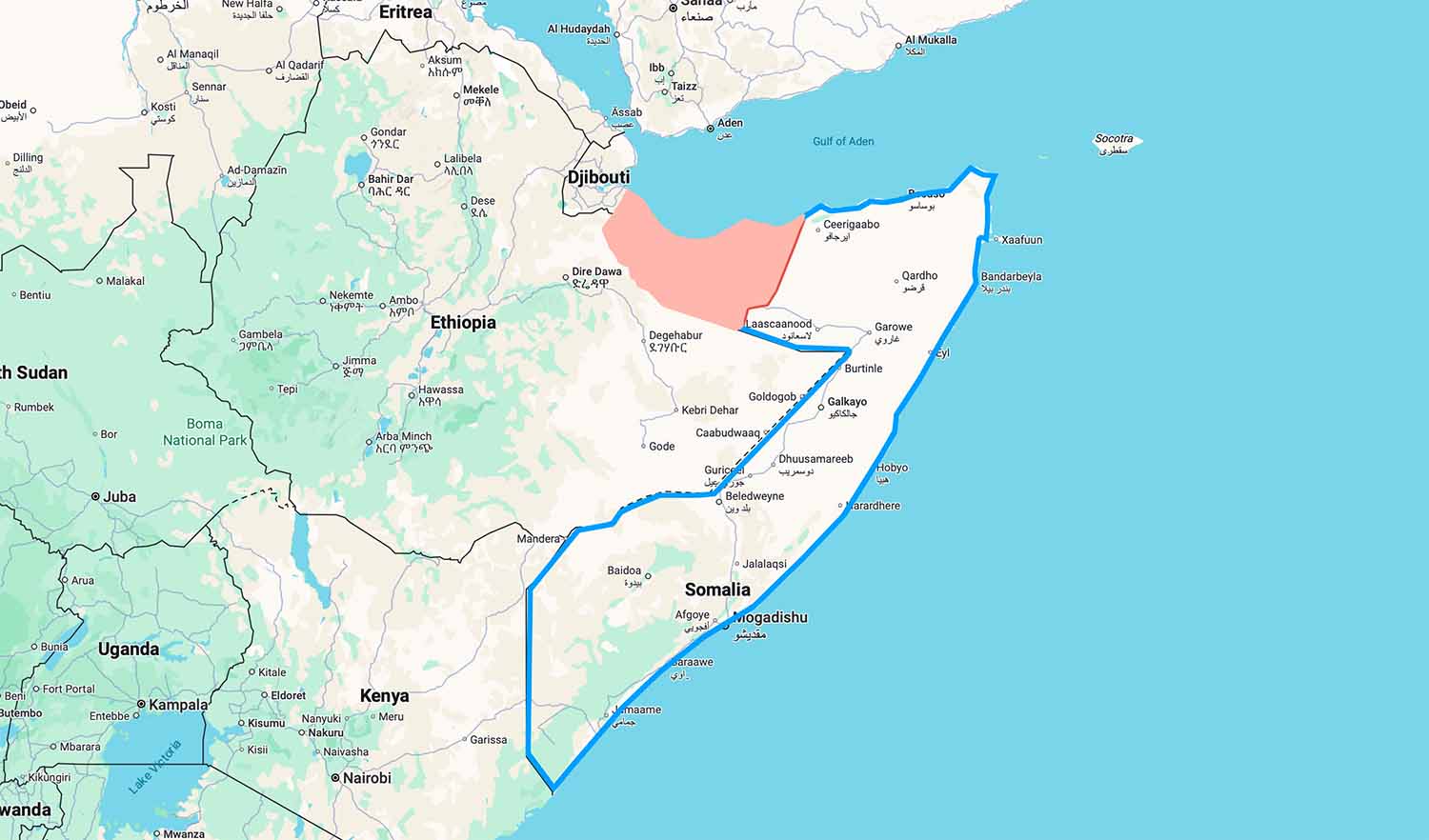
Somaliland

map of somaliland and somalia

Somaliland is home to approximately six million people and occupies an area of 176,000 square km, which makes about three quarters the size of Britain. It borders Somalia to the east and is not recognised as an independent state by any country except Israel.

The area edged blue in this map is Somalia. From Somalia’s point of view the blue line continues around the pink area. In the view of Somaliland the pink area is Somaliland.

Somaliland is not a breakaway province of Somalia. Rather, in the late 19th century, the Somali sultanates were colonised by the Italian and British empires, who created two colonies from the tribal territories: Italian Somaliland and British Somaliland.

Britain formally granted independence to the State of Somaliland in June 1960, and almost immediately Somaliland voluntarily united with the former Italian Somaliland to form the Somali Republic.

Things didn’t go smoothly, however, and the union didn’t last. Eventually war broke out, and after ten years Somaliland declared independence in 1991.

Israel recognised Somaliland as an independent state last December. To cement that, the first official delegation from Somaliland arrived in Israel on Monday 23rd February 2026.

So from 1991 until last December, Somaliland has been in a nether world of being home to its people but not recognised as a country.

That is not to say it was ignored, because it has relations with a number of countries. But by making the step to formally recognise Somaliland, perhaps Israel will cause the floodgates to open.

Israel has reason to want a partner in the Horn of Africa. It helps to counter Iranian-back Houthis in Yemen. But as of just a day or two ago, that dynamic has changed with the US and Israeli attacks on Iran. That said, a partner is a partner, particularly in this changing world. I guess the parties probably stressed that when they met.

President Nicolás Maduro

President Trump has consistently berated Zelensky for not giving way to Putin’s demands. He seems to be saying that sometimes the best deal is the one that hurts but at least is a deal, because without a deal the outcome will be much worse. Is he looking as an outside observer? Does he think that cutting Europe loose is a better outcome for the USA than taking a stand with Europe? Does he have another agenda?

With the invasion of Venezuela to capture President Nicolás Maduro, the USA has nicely undercut its ‘sovereign territory’ objection to the Russian invasion of Ukraine. I am sure that President Trump, President Zelenskyy of the Ukraine, and President Putin of Russian Federation are acutely aware of this.

Each will have their own reasons and motives for drawing parallels and of saying that the analogy has limits and what applies to one does or does not apply to the other. But whichever way it is described, President Trump has handed President Putin an argument that sways the balance away from support of Ukraine. Perhaps that is what he wants. He might have handed himself an argument for abandoning Ukraine and Europe without having to shoulder responsibility for having done that.

Drought In Iran

Tehran’s dams are currently at about 19% capacity. Because of Iran’s history as a funder of terrorism, it is tempting to see the drought as payback. This may well affect the extent to which others will help Iran in its crisis. And that leaves aside the question of whether any country can actually help.

To say that Iran’s problems are because it is intensely urbanised, needs context. After all, the population density of Britain is nearly five times that of Iran.

The population of Iran is 91.57 million. The population of the Tehran is 9.6 million but the population of the greater metropolitan area is 16.8 million. That equates to more than 18% of the population of the country living in the capital.

The combined populations of Iran’s next six biggest cities – Mashhad Isfahan, Karaj, Shiraz, Tabriz, and Qom – totals another 16 million people. So that equates to more than a third of the population of the country living in the cities.

But urbanisation in Iran is recent. Poor harvests have caused a drift to the cities. And it has left a gaping hole in rural areas where agriculture is outdated and inefficient, and there’s no one to work the fields. Yet agriculture in Iran consumes 90% of the available water.

Seven Lean Years?

Iran has had five consecutive years of drought. The rainfall in the last year has dropped by 45% below the longterm average, and by spring of this year, over half of Iran’s reservoirs were empty.

Temperatures have been over 50 °C in parts of Iran, worsening the crisis and triggering power and water outages. The prediction is that Tehran could be out of water within weeks. What happens when millions of people in the cities have no water?

Since May 2025, widespread protests have erupted across Iran over water and power shortages, particularly in the poorest areas, with a risk of social and political destabilisation.

Syria

Between 2006 and 2010, Syria had its worst ever drought. The UN estimated that around 800,000 farmers lost their livelihoods because of it. Crop failures triggered millions of Syrians coming to the cities. That led to protests, and from there to State repression and from there to civil war.

Afghanistan

Within the last year, Afghanistan built the Pashdan dam on the Harirud River that has dried up the Harirud border basin beyond the dam and threatened the city of Mashhad in Iran. Iran objects to the denial of access to a water source that it is says is intended to be for the benefit of the region. But what is it going to do?

It’s significant for Iran because the population of the Mashhad metropolitan area is 3.46 million, making it the second largest city in Iran after Tehran.

And it is not the only country affected by Afghanistan’s plans. When the Qosh Tepa canal is completed and starts diverting water to the north of the country, it will threaten the water supplies of Uzbekistan and Turkmenistan.

In the longer term, what might happen? Social breakdown iand regime change in Iran might be a consequence of drought but it doesn’t solve the problem of lack of water.

Perhaps an alliance of Iran, Uzbekistan and Turkmenistan in a war against Afghanistan. It’s all possible, although how anyone could breach the Pashdan dam to restore the access is a nice question because it is a huge earth structure.

Perhaps Iran might accept technological help from Israel, the world’s leader in desalination. Iran has access to the Caspian Sea, which is about a third as saline as the oceans and you would think that is perfect for desalination. Israel has offered to help Iran with desalination but Iran has so far refused. That would be an interesting turnaround if Iran’s future was made more secure by Israel.

Iran Update February 2026

The drought continues. Authorities have started rationing water at night and President Masoud Pezeshkian has discussed evacuating the capital.

Iran invested heavily in large-scale dams in the late 20th century, and there are over 500 dams in the country. As of now, though, roughly 64% of the reservoirs are empty and nineteen major dams across the country are at less than 20% capacity.

The drift from the countryside continues. Because of drying wetlands and the inability to sustain farming, approximately 31,000 villages, nearly 45% of Iran’s rural settlements, are now deserted.