Count Your Blessings

Who was the first person to say count your blessings? It must have been a long time ago. And over the years, like with all things, the meaning gets trampled down and overlooked.

So let’s start again and spend time counting them, looking at them, seeing what they are. It may be many people have similar blessings but we know that not everybody is blessed with the same. And what is a blessing? What’s implied in the word blessing is that whatever one is blessed with – that blessing comes from outside.

If we could control everything then we could say it’s not a blessing; it’s my characteristic and I started it and I begat it and I control it and I decide whether it exists or it doesn’t exist

And we know this isn’t true.

We have a choice to say we are not victims but rather we are recipients. We are the receivers and if we receive we must receive from outside and where the outside is, well that’s a different question and we don’t have to think about it now.

But we can recognise a blessing is what you are blessed with and we can take a moment to stand still and feel the outside; we can all do that.

Polar Bears and Rare Earth Deposits

I wrote this article in 2011 under the title ‘Polar Bears Poisoned And New Rare Earth Deposits Found’ – but the article was lost when I rebuilt this site. So I am re-publishing it here.

The fifteen lanthanide elements from lanthanum to lutetium – together with scandium and yttrium – are generally known as the rare earth elements.

They are essential in the production of TVs, phones, computers, and batteries.

Until now there has been a shortage of rare earths, exacerbated by China saying last December [ that would be December 2010 ] that it wanted to keep what is has – and it has almost all of the ore deposits.

That all changed last week when Japanese scientists announced that they had found huge deposits in international waters off Hawaii – deposits that are easy to get at and low in the associated radioactive materials usually found with them.

So that is good news for everyone who wants a phone, or a TV, or a computer.

And it is bad news for polar bears – and then for us.

The UK TV channel Channel 4 showed a program about polar bears in Svalbard in the north of Norway.

The programme was one in the series Inside Nature’s Giants that followed a team of veterinarians who carry out autopsies on elephants, giraffes, and other big animals.

The aim is to educate veterinary students (and the TV audience) about the special characteristics that enables each species to live as it does.

The autopsy on the polar bear was different in that it was ‘in the field’ in Svalbard and the polar bears were ones that the local Inuit hunters had hunted for food.

The programme was also different in that there were interviews with other teams of scientists who are in Svalbard investigating how polar bears are suffering from biological changes brought on by what they eat.

Specifically, they are losing sexuality, developing tumours, becoming weaker, and losing offspring.

What emerged was that because polar bears are at the top of the food chain, they are being poisoned by eating concentrated amounts of flame retardants.

Flame retardants are used in the plastics in TVs, phones, computers, etc. They are organohalogen and organophosphate compounds and they are released into the atmosphere when the products are recycled.

The products are recycled in countries like India – broken down by burning to get at the expensive rare earth metals within – and the flame retardant chemicals escape into the atmosphere and are carried thousands of miles around the world and up the food chain to polar bears (and I guess to the Inuit who eat the bears).

So just at the time that the scientific community is able to demonstrate the danger from these chemical flame retardants, a new source of rare earths is found – with the result that more and more TVs and phones can be made.
Nofence Grazing

The Yorkshire Wildlife Trust uses a method of keeping cattle in a location without fencing them in. I asked what no fence grazing is and got this reply. Before I start, I want to say that I am very aware that criticism is easy and it may be that the experience of herds with nofence is entirely positive. But I worry that it is otherwise.

The explanation of nofence is on the website at nofence. A cow is pictured with a collar with a box hanging from its neck.

Nofence trains the animals to turn around on audio. When the animal crosses the Nofence boundary, the collar starts playing an audio warning. The audio warning is a scale of tones, which starts at a low pitch and rises gradually as the animal moves through the boundary zone. If the whole scale has been played, a mild, but effective electric pulse will be given.

So there is it – a shock is delivered to an animal if it ignores the boundary. I prefer the idea of a fence, and I wonder what cows prefer. A fence you can see. It requires no translation from rising tones to a shock that comes from around its neck. How is it to make sense of anything other than that a rising tone spells an unpleasant experience?

One of the advantages touted by the system is that the boundaries can be moved easily. And if they are then a cow cannot reliably relate the rising tone to specific landmarks or its position in the landscape. Imagine being in a field and someone switches the no-go zone. I don’t know.

Making A Sand Mandala

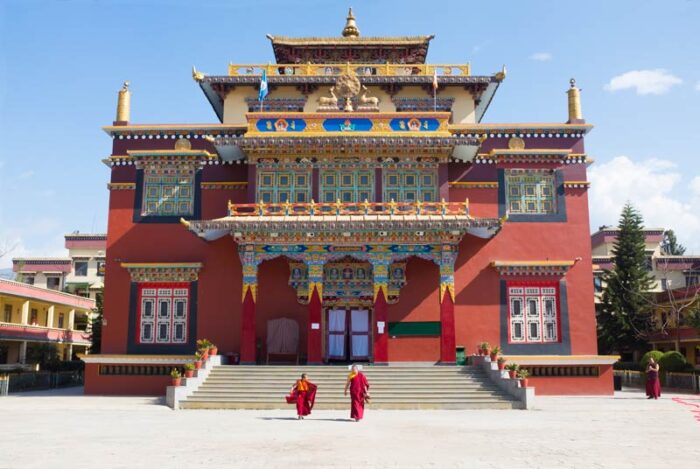
In a Buddhist monastery in Nepal a group of seven or eight young monks were making a sand mandala. The mandala was in three levels, a large base level several feet across; another smaller level raised on support legs; and then a third, smaller level above that. I cannot remember what the bases were made of, perhaps thin sheets of wood or metal. But I remember the process they used to make the pattern on the mandala.

The monks were lying down around the mandala, each working on a part of the pattern. Each monk had a small tool that he used to release fine coloured sand in a precise manner. As they moved their tools along, the monks ‘drew or painted’ the sand on the bases, to make one highly detailed pattern in many colours. Mandalas follow an established pattern, which means that the monks are not designing it from scratch, but rather ‘painting by numbers’ as it were, but in sand.

The tool each of them used to release coloured sand was in two parts – a long, slim conical tube and a rod.

The sand was released from the conical tube, which was about a foot long. The coloured sand was loaded into the wide end, and came out of the narrow end. But the hole at the narrow end was extremely tiny. It was so tiny that a monk could ‘draw’ a fine line if he wanted, as he moved the tube along.

The hole was so tiny that the sand did not fall out of the narrow end of the tube under its own power of gravity. It had to be coaxed out of the tube, and for that the monks used rods several inches long. The conical tubes were smooth on the outside except for one section where the surface was made into small ridges and grooves running at right angles to the length of the tube. Together the ridges made a tiny staircase from the bottom to the top of the tool. The monks rubbed the rods gently back and forth over the ridges, and that coaxed the sand out of the tubes so that they were painting with sand.

Now, having got this far you may be wondering why I am devoting so much time to describing the process. Well, first the process is very painstaking and detailed. It takes effort, concentration, and patience to paint the design in sand and to fill in areas of colour with sand coming out of such a tiny hole in the end of the tube.

It is obvious that it would take days to finish. I can’t really remember the speed at which they were working, but maybe it would take them a week to complete it.

And the monks are working very close to one another and have to be aware of each other’s feet and legs and arms or they risk jerking or crashing into one another or the mandala and upsetting the pattern.

In order to make a sand mandala, the monks have to work together. If there was resentment, pride, superiority, or any sense of inequality in the mind of any one of them, it would set up tension. I think that would translate to the work and could be seen in the quality of the work. Pretty soon there’d be an accident and someone would knock against the design. I am sure the monks were all aware of that.

A mandala represents a truth, and its meaning is bound up in Buddhist teachings. Sand mandalas are ceremoniously thrown away, and that impermanence is essential to the purpose of their creation. So what the monks are working on inevitably brings about contemplation of themselves. The process of creating the mandala builds the ability of the monks to form a brotherly relationship. Someone could look at the building of good relationships as incidental to the creation of the mandala, or they could look at it as the very purpose for which the work was done.

shechen-monastery-in-boudhanath.

.