Project 100,000

There’s a scene in the film Full Metal Jacket where a raw recruit joins the platoon and is instructed not to leave the path. He is of limited ability and unable to follow instructions. No sooner does he join the platoon than he leaves the path and is skewered in a Vietcong man trap.

In Apocalypse Now there’s a scene where the young soldier, hardly able to follow any orders, wasted on dope, starts shooting wildly. He is out of control, as much a terrified observer as an active combatant.

And in Forrest Gump the hero joins the army and miraculously manages to survive and do well despite being odd and below average in IQ. The way things work out well for him are fantastical. That’s a device used repeatedly in the film.

The war in Full Metal Jacket, Apocalypse Now, and Forrest Gump is the Vietnam War.

You might wonder how men of below average IQ ever got into the army. I knew that people from poor backgrounds, disproportionately black, were most likely to be drafted, but I didn’t wonder at all beyond that. I just watched the films.

Hamilton Gregory

But today I watched a talk by Hamilton Gregory, a man who volunteered for service in Vietnam. He was a college graduate, so he could well have avoided the draft. Many middle class young men did. They didn’t have to try hard; there were exemptions of which they could take advantage.

But Mr Gregory volunteered and as chance would have it, he was ordered to escort another recruit to Fort Benning in Georgia. That recruit was educationally subnormal. He didn’t know that America was at war. He didn’t know in which state he had been born.

Hundreds of thousands of men like him were drafted under Robert McNamara’s Project 100,000. That was the project under which young men of poor IQ were inducted each year.

Robert McNamara

Robert McNamara was the U.S. Secretary of Defence, so it was his call. The army couldn’t get people to go to Vietnam, So McNamara lowered the IQ requirement. He said that the army was one of the world’s best educators, and it could raise the IQs of the draftees. So people who were previously unfit to server were now fit.

In battle they were too slow to react, too slow to understand what was going on, two slow to formulate a plan. They were poor marksmen, erratic and a danger to themselves and their fellow soldiers. And they died in Vietnam at three times the rate other soldiers were killed.

Unofficially, the soldiers in McNamara’s Project 100,000 were called McNamara’s Morons.

Hamilton Gregory was so appalled by Project 100,000 that after the war he gathered evidence and wrote McNamara’s Folly: The Use Of Low IQ Troops In The Vietnam War. And that is what he was talking about in the video I watched.

So now I wonder whether the makers of Full Metal Jacket, Apocalypse Now, and Forrest Gump knew about Project 100,000 and whether they were making a reference to it?

Escape In The Mind

I didn’t really like Forrest Gump that much. I know there was some homegrown wisdom peeking out of that character, some humanity that would not be denied. But I wasn’t fond of the fantastical element because I knew that being saved and prospering is not what generally happens to people like Forrest Gump.

Sure, it has to happen by random chance to someone, even to a person with limited abilities. But still, it seemed like a cop-out, a way of making the audience think that things are good, when in truth they are not.

Reality

In contrast, there’s the film Brazil. It’s fantastical in that the world depicted in the film is odd, odd like in a Kafka novel, but yet near enough for us to be able to recognise it. Life could be like that with just a bit of a shift sideways.

There are the scenes in Brazil where a ninja appears out of nowhere to save the main character. He does so repeatedly. He sweeps in just when things look bad. But in the final scenes, in the end we see that these rescues were an illusion, an attempt by the main character to escape mentally from the horror of torture.

Brazil is depressing. The baddies win and there is no redemption. It’s 1984 in film. But I can live with that more easily than being fed a diet of heroism from characters that were three times more likely to die in war than their fellow soldiers.
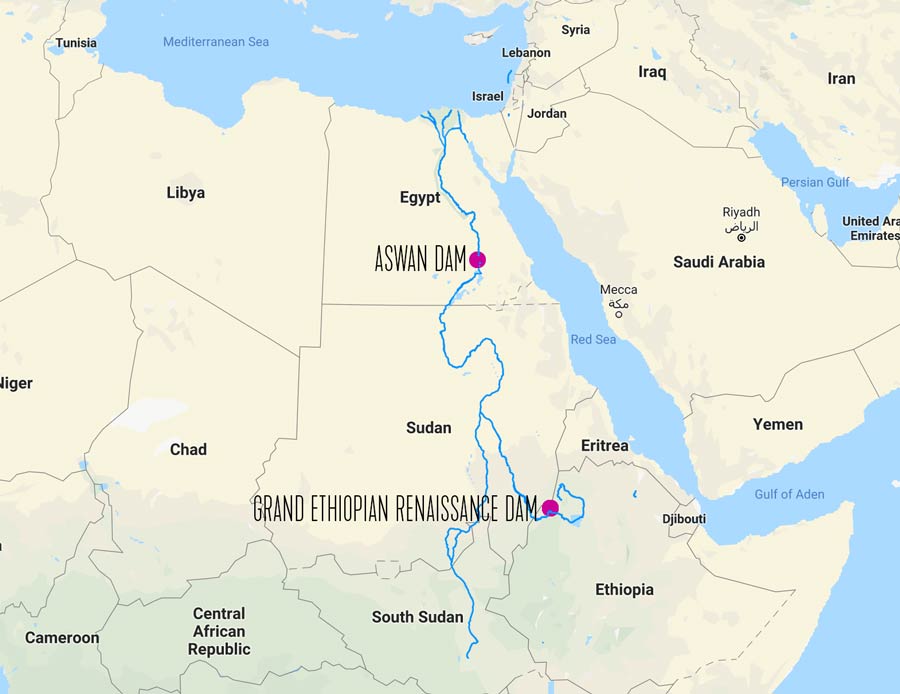
The Grand Ethiopian Renaissance Dam

The Grand Ethiopian Renaissance Dam in Ethiopia is nearing completion. Egypt wants a say in how quickly the dam fills and how much is released and when.

It is easy to see why Egypt would want that control. Egypt has a dam of its own. The Aswan Dam in Egypt, completed in 1970, enables Egypt to even out the water that reaches the land in the Nile Delta. But the Nile in Egypt is downstream, so it doesn’t matter how efficiently the Aswan Dam is managed if not enough water reaches it.

In a word, if Ethiopia holds back on the water it allows down the Nile, It will damage Egypt’s fortunes.

Ethiopia has accused Egypt of hydrological colonialism for trying to control how Ethiopia manages the flow from its new dam.

Egypt says that water that flows through more than one country is an international resource. As such, it must be governed by all the concerned parties.

Electricity

As well as controlling water for agriculture, the turbines powered by the dam’s water outflow will provide electrical power for Ethiopia.

And Ethiopia plans to sell the excess electricity generated to neighbouring countries. The power lines are already going in.

But it is not just Ethiopia, Egypt and water. There may be another player in the game.

Who Financed The Grand Ethiopian Renaissance Dam

Ethiopia funded the dam by issuing bonds to nationals in Ethiopia and Ethiopians abroad. It said is was forced to take that route because Egypt pressured international funders to refuse to back the project.

What is not clear is who financed the turbines. The turbines are a big part of the project and the most technical. They are Chinese built, but who paid for them? China?

There’s a statement in Wikpedia, but no source given:

the turbines and associated electrical equipment of the hydropower plants costing about US$1.8 billion are reportedly financed by Chinese banks“.

If that statement is true, then it’s perhaps another example of external finance leading to control when the debtor country cannot repay the debt.

China has been accused of it before. And it is, of course, not the only country accused of that.

So maybe it is a race that Ethiopia has to run. It has to increase agricultural production. It has to encourage new projects within the country that consume that electricity. And it has to make money from selling electricity to neighbouring countries.

And to do so while keeping up payments for the turbines.

Last week, Ethiopian Prime Minister Abiy Ahmed was awarded the Nobel Peace Prize.

map showing the location of the aswan dam and the grand ethiopian renaissance dam

Judy: Film Review

What did I think of the film? It was depressing. It’s the story of Judy Garland. It’s the story of a woman with a wonderful voice who was starstruck with her own stardom. It’s the story of a Hollywood mogul who gave her a tough time when she tried to break out of the straitjacket existence in the movies that she signed up for.

It’s the story of a woman who loved her children but would not seek help to get off the pills she had been on since a teenager. The pills were forced on her by her mother. She had pills to keep her thin, pills to get her up, and pills to get her to sleep.

So give her a break, she was messed up.

Yes, OK. I give her a break. But it wasn’t enough for a film. It was a dramatised documentary. And it was all about her, except for the scenes with the gay couple in their flat trying to make a meal for them and her and enjoying the poignancy of each others’ company. That was nice.

When one of them falls asleep on the sofa late at night, his partner talks about how his partner was in prison for homosexuality, and says ironically and knowingly and wistfully that since the change in the law it appears they didn’t do anything wrong all along. Nice social commentary.

Renee Zellweger was very impressive near the end when she moved around the stage. I mean she was impressive irrespective of what character she was supposed to be playing.

And she captured some ‘Judy Garland looks’ and those almost black eyes. But, it didn’t amount to a film. And if it did, it was depressing. No redeeming end, just a very British bit of cake in a cafe with Bernard Delfont’s uptight personal assistant and a nervous band leader.

The worst part of the film were the credits, the credits in gold sparkle against a black background. They seem designed by someone who thought that we the audience would be so stricken by the emotional intensity of the film that we would stare spellbound at the names as they came up sparkle by sparkle and then faded, slowly.

Except that the snail’s pace at which the sparkles sparked and faded was not emotionally charged; it was ponderous.

The names of the producers and the associate producers in sparkles just had me wondering when the lights would go up in the cinema. In fact, I thought, did someone associated with the film insist that venues keep the lights down until those names had passed and the rest of the credits could begin?

Kurds In Syria, And The EU

The news is all about how Turkey is attacking the Kurds in Syria. It is probably true because the Kurdish independence movement in Turkey is a banned terrorist organisation. It’s banned because the Kurds would like to hive off a part of Turkey and Syria and declare it their homeland and a new state.

But the news is missing something. Turkey has been complaining for months that the EU is not paying the contribution it promised Turkey for playing host to the Syrian refugees in Turkey – currently about 3.6 million of them. So Turkey has invaded Syria to create a safe zone it can tip the refugees into, and to be able to turn to the world and tell them it’s their problem.

Turkey is trying to solve two problems at once – remove the refugees and under the guise of that to neutralise the Kurds.

The news also missed that Greece has been complaining to the EU about the same thing – that the EU is not paying what it promised for the upkeep of the refugees.

There is a question also as to whether some or perhaps most of the refugees are in fact economic migrants who see the opportunity to create a better life in Europe. It’s clear that the refugees or economic migrants, if that is what they are, do not want to stay in Turkey: They want to come to Europe.

The whole reason that the EU agreed to pay towards the upkeep in the first place was because Turkey threatened to open its northern borders and just let the refugees/migrants through if the EU didn’t see it as an international problem.

Another snippet of news is that EU representatives were in Turkey last week trying to hammer something out. They were also in Greece because Greece has the same refugee problem on a smaller scale. There were riots on the island of Lesbos last week. Greece’s refugee problem won’t be on a smaller scale if Turkey opens its borders.

The next step along the way from Turkey to Europe is via Greece. Then it is a short hop across the Aegean to Italy, or a long walk via Bulgaria, Romania, and then to Hungary. But Hungary with its hard Right Government bent on repulsing the refugees / economic migrants, means that Italy is the soft spot on the route north.

Is the EU paying its share

In 2016 the EU struck a deal with Turkey under which the EU could start sending illegal immigrants back to Turkey and Turkey would play host to those immigrants / economic migrants / refugees sent back and to the ones that were within its borders. In return, the EU would look at relaxing visa requirements for Turkish citizens wanting to get into Europe; would speed up negotiations on Turkey’s EU membership. and it would pay for the upkeep of the immigrants / economic migrants / refugees in Turkey.

Amnesty UK tweeted then that it was ‘a dark day for the refugee convention, a dark day for Europe and a dark day for humanity.’

Three years down the line and the EU complains that Turkey has not implemented the EU’s requirements on human rights upon which the negotiations on Turkey’s EU membership depended.

Turkey, for its part, complains that the EU has not paid what it owes.

Would Turkey ever be allowed into the EU? I seem to recall that one of the arguments for Britain withdrawing from the EU was that ‘hordes’ of Turks would ‘invade’ Europe. Is the immigrant / economic migrant / refugee deal just a stop gap, a way of kicking the can down the road while other means of stopping them are developed?

What are those other means? To make their home countries safe again? How is that working out?

So where are we?

Turkey wants rid of Kurdish statehood ambitions, but it also wants rid of its 3.6 million Syrian refugees / asylum seekers / economic migrants / (choose your epithet according to your understanding) – and the EU hasn’t (according to Turkey) been paying what it promised under the 2016 agreement whereby Turkey would host the Syrian refugees rather than allow them onwards into Europe.

Under that 2016 agreement, Turkey would even take in those who has already made it to the EU and which the EU could now send back to Turkey.

The EU was also supposed to fast-track Turkey’s accession to the EU and meanwhile relax visa requirements for Turks. Turkey’s human rights record is going the ‘wrong’ way, so the EU is upset (and is secretly happy to continue to be upset because many EU countries would veto Turkey’s accession under any scenario).

So this way, Turkey sets up a buffer zone in northern Syria and will send the Syrian refugees there and under the guise of that it will ‘alleviate’ its Kurdish independence problem. It’s a messy world, and the EU will get its way without having to pay any more to Syria.

Where Is The Kurds Homeland

Kurdistan is a high plateau and mountainous region covering a large part of eastern Turkey, northern Iraq, and western Iran and smaller areas in the north of Syria and Armenia.

Iran recognises the province of Kurdistan within its country’s borders and Iraq recognises the Kurdish autonomous region within its country’s borders. No one recognises Kurdistan as an independent country.

map of Kurdistan showing how it covers a large part of eastern Turkey, northern Iraq, and western Iran and smaller areas in the north of Syria and Armenia.