Apple, Ireland, EU, Juncker, and Tax

From Marginal Seat 2 September 2016

Ireland has just confirmed that it will fight the EU tax bill imposed on Apple in Ireland.

The tax bill was imposed by Margarethe Vestager, the European Commissioner for Competition.

According to Reuter’s, Vestager said that

since being alerted to Apple’s methods and other cases by a U.S. Senate probe in 2013, the Commission has been looking through about 1,000 such instances in the EU

This row has been brewing for years.

In 2014, the Consortium of Investigative Journalists operating out of Washington DC disclosed leaked documents they said showed Luxembourg had become a centre of corporate tax avoidance for over three hundred major international companies.

And Jean-Claude Juncker, the current President of the European Commission, was prime minister of Luxembourg from 1995 to 2013, and is accused of being involved in the agreements.

As the Guardian revealed in 2014

The leaked papers show Luxembourg acting as a go-between, both enabling and masking tax avoidance, which always takes place beyond its borders. The documents are mainly Advance Tax Agreements – known as comfort letters. The leaked papers include 548 of these private tax rulings. These ATAs are typically schemes put to the Luxembourg tax authorities which, if implemented, reduce tax bills substantially. If the Luxembourg authorities approve the scheme they provide a comfort letter which is a binding agreement.

If the EU Commission wins on appeal, then a whole raft of tax matters will unravel and Luxembourg’s head will be on a plate.

It’s not just tax, though. As always, sweetheart deals are done for a reason. And if the deals are upset, there can be consequences.

In 2015, Vestager ordered Cyprus Airways to pay back millions in state aid it had received in a restructuring package.

Vestager said that under the EU rules, there must be ten years or more between state bailouts that companies receive, and Cyprus Airways had already been bailed out in 2007.

So another bailout was a disguised way for the state to subsidise the airline, which meant unfair competition with other airlines.

As a result, Cyprus Airways went out of business, jobs were lost and those ‘other’ airlines picked up the business.

So the result was that the office of the Commission for Competition in the EU reduced competition by driving one of the airlines out of business.

That may be necessary fallout of a decision to defeat tax avoidance in the EU.

But who know what the eventual consequences will be? 

And who knows what the politics within the EU will decide in the background to the forthcoming appeal, given the embarrassment to Juncker?

This could get messy.
Iran Nuclear Deal Dispute Resolution

A year and a half ago everyone knew that Iran was in breach of the nuclear deal. So why only now have the UK, France, and Germany triggered the Iran Nuclear deal dispute resolution process?

When President Trump gave his speech in Riyadh in March 2017, he made it clear that he had the agreement of the Middle East states to oppose Iran, a country that funds terror in the region. He mentioned Iran about a dozen times in his speech, far more than any other country.

A year later Germany, France, and the UK were hanging on, fighting to preserve the Iran deal.

But they had a lot invested in projects in Iran for the supply of major infrastructure.

Those European deals were all done when the Iran agreement was in place. But it raised the question over the motives of the Europeans who wanted to preserve the Iran agreement. They knew their financial stake was at risk.

Making Hay While The Sanctions Bite

One can be pretty sure that Trump knew of the consequences for European investment if the USA withdrew from the Iran agreement and imposed sanctions that the Europeans had to follow sooner or later. And that he knew that the US would benefit from the Europeans’ losses.

Of course, with Iran’s declared intentions in the region, it makes one wonder why the Europeans invested so much in what was probably going to turn out badly in the end?

And it also makes one wonder why the Europeans didn’t see the writing on the wall with the Riyadh speech, and make preparations to pull back from heavy investment in Iran.

Iran Nuclear deal dispute resolution process

The news yesterday was that Britain, France and Germany have triggered the Iran Nuclear deal dispute resolution process.

Depending on how that pans out, they could encourage the UN to impose sanctions on Iran again.

Triggering the process has been described as an action taken more in sorrow than anger but in recognition that Iran might be less than a year away from having the expertise to develop a nuclear bomb.

Maybe the decision was taken more in sorrow than in anger. But sorrow over what? Sorrow over a confrontation with Iran? That was always on the horizon. Maybe it is over the lost investments in Iran’s infrastructure?

On the bright side for Britain, France, and Germany, maybe they have wound down their deals and minimised their exposure and can afford to do what they should have done a year and a half ago.

The previous Administrations before President Obama’s Administration kicked the can down the road. The Obama Administration sealed the Iran nuclear deal.

The Trump Administration says it was a bad deal because the Iranians had acted and were continuing to act in bad faith. They say Iran has continued to enrich Uranium secretly and was playing the West for fools.

Netanyahu thinks similarly. Of course Israel has to deal with Hezbollah on its border with Syria, and Hezbollah is financed by Iran. The judgement of the Israelis is partially formed by that reality.

Protests Inside Iran

Iranians have been on the streets protesting for months. They complain that their living standards have worsened because of the actions of the regime. With the downing of the Ukrainian airliner the regime is on the defensive. That has given renewed energy to the protesters, and who knows what the tipping point is? We could read tomorrow about regime change or brutal repression. Either is possible.

So where is it all heading? Will sanctions make the Iranian regime fall? If they do, will it happen before Iran gets a bomb?

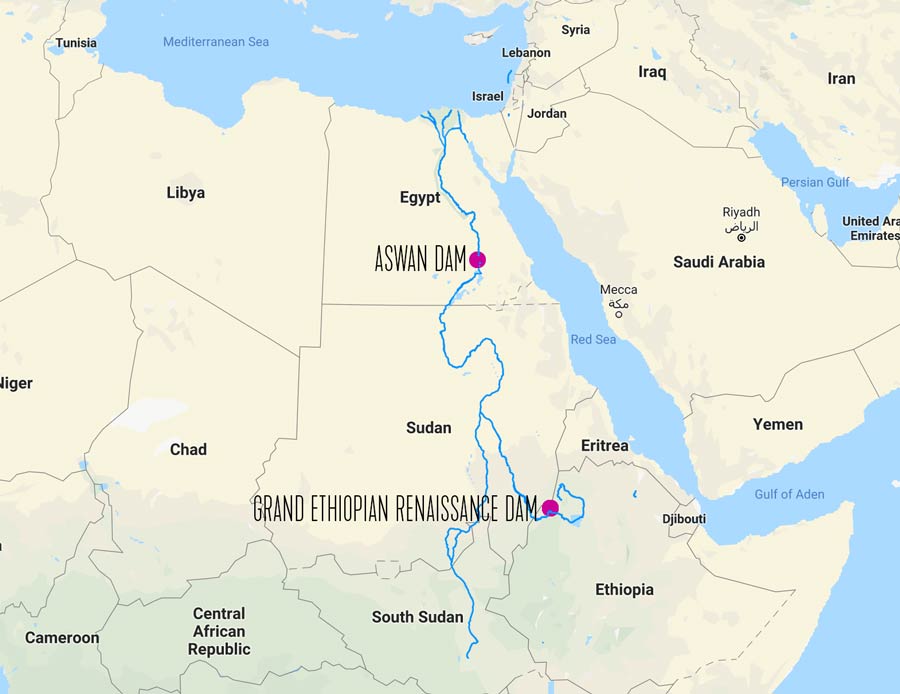
The Grand Ethiopian Renaissance Dam

The Grand Ethiopian Renaissance Dam in Ethiopia is nearing completion. Egypt wants a say in how quickly the dam fills and how much is released and when.

It is easy to see why Egypt would want that control. Egypt has a dam of its own. The Aswan Dam in Egypt, completed in 1970, enables Egypt to even out the water that reaches the land in the Nile Delta. But the Nile in Egypt is downstream, so it doesn’t matter how efficiently the Aswan Dam is managed if not enough water reaches it.

In a word, if Ethiopia holds back on the water it allows down the Nile, It will damage Egypt’s fortunes.

Ethiopia has accused Egypt of hydrological colonialism for trying to control how Ethiopia manages the flow from its new dam.

Egypt says that water that flows through more than one country is an international resource. As such, it must be governed by all the concerned parties.

Electricity

As well as controlling water for agriculture, the turbines powered by the dam’s water outflow will provide electrical power for Ethiopia.

And Ethiopia plans to sell the excess electricity generated to neighbouring countries. The power lines are already going in.

But it is not just Ethiopia, Egypt and water. There may be another player in the game.

Who Financed The Grand Ethiopian Renaissance Dam

Ethiopia funded the dam by issuing bonds to nationals in Ethiopia and Ethiopians abroad. It said is was forced to take that route because Egypt pressured international funders to refuse to back the project.

What is not clear is who financed the turbines. The turbines are a big part of the project and the most technical. They are Chinese built, but who paid for them? China?

There’s a statement in Wikpedia, but no source given:

the turbines and associated electrical equipment of the hydropower plants costing about US$1.8 billion are reportedly financed by Chinese banks“.

If that statement is true, then it’s perhaps another example of external finance leading to control when the debtor country cannot repay the debt.

China has been accused of it before. And it is, of course, not the only country accused of that.

So maybe it is a race that Ethiopia has to run. It has to increase agricultural production. It has to encourage new projects within the country that consume that electricity. And it has to make money from selling electricity to neighbouring countries.

And to do so while keeping up payments for the turbines.

Last week, Ethiopian Prime Minister Abiy Ahmed was awarded the Nobel Peace Prize.

map showing the location of the aswan dam and the grand ethiopian renaissance dam

Kurds In Syria, And The EU

The news is all about how Turkey is attacking the Kurds in Syria. It is probably true because the Kurdish independence movement in Turkey is a banned terrorist organisation. It’s banned because the Kurds would like to hive off a part of Turkey and Syria and declare it their homeland and a new state.

But the news is missing something. Turkey has been complaining for months that the EU is not paying the contribution it promised Turkey for playing host to the Syrian refugees in Turkey – currently about 3.6 million of them. So Turkey has invaded Syria to create a safe zone it can tip the refugees into, and to be able to turn to the world and tell them it’s their problem.

Turkey is trying to solve two problems at once – remove the refugees and under the guise of that to neutralise the Kurds.

The news also missed that Greece has been complaining to the EU about the same thing – that the EU is not paying what it promised for the upkeep of the refugees.

There is a question also as to whether some or perhaps most of the refugees are in fact economic migrants who see the opportunity to create a better life in Europe. It’s clear that the refugees or economic migrants, if that is what they are, do not want to stay in Turkey: They want to come to Europe.

The whole reason that the EU agreed to pay towards the upkeep in the first place was because Turkey threatened to open its northern borders and just let the refugees/migrants through if the EU didn’t see it as an international problem.

Another snippet of news is that EU representatives were in Turkey last week trying to hammer something out. They were also in Greece because Greece has the same refugee problem on a smaller scale. There were riots on the island of Lesbos last week. Greece’s refugee problem won’t be on a smaller scale if Turkey opens its borders.

The next step along the way from Turkey to Europe is via Greece. Then it is a short hop across the Aegean to Italy, or a long walk via Bulgaria, Romania, and then to Hungary. But Hungary with its hard Right Government bent on repulsing the refugees / economic migrants, means that Italy is the soft spot on the route north.

Is the EU paying its share

In 2016 the EU struck a deal with Turkey under which the EU could start sending illegal immigrants back to Turkey and Turkey would play host to those immigrants / economic migrants / refugees sent back and to the ones that were within its borders. In return, the EU would look at relaxing visa requirements for Turkish citizens wanting to get into Europe; would speed up negotiations on Turkey’s EU membership. and it would pay for the upkeep of the immigrants / economic migrants / refugees in Turkey.

Amnesty UK tweeted then that it was ‘a dark day for the refugee convention, a dark day for Europe and a dark day for humanity.’

Three years down the line and the EU complains that Turkey has not implemented the EU’s requirements on human rights upon which the negotiations on Turkey’s EU membership depended.

Turkey, for its part, complains that the EU has not paid what it owes.

Would Turkey ever be allowed into the EU? I seem to recall that one of the arguments for Britain withdrawing from the EU was that ‘hordes’ of Turks would ‘invade’ Europe. Is the immigrant / economic migrant / refugee deal just a stop gap, a way of kicking the can down the road while other means of stopping them are developed?

What are those other means? To make their home countries safe again? How is that working out?

So where are we?

Turkey wants rid of Kurdish statehood ambitions, but it also wants rid of its 3.6 million Syrian refugees / asylum seekers / economic migrants / (choose your epithet according to your understanding) – and the EU hasn’t (according to Turkey) been paying what it promised under the 2016 agreement whereby Turkey would host the Syrian refugees rather than allow them onwards into Europe.

Under that 2016 agreement, Turkey would even take in those who has already made it to the EU and which the EU could now send back to Turkey.

The EU was also supposed to fast-track Turkey’s accession to the EU and meanwhile relax visa requirements for Turks. Turkey’s human rights record is going the ‘wrong’ way, so the EU is upset (and is secretly happy to continue to be upset because many EU countries would veto Turkey’s accession under any scenario).

So this way, Turkey sets up a buffer zone in northern Syria and will send the Syrian refugees there and under the guise of that it will ‘alleviate’ its Kurdish independence problem. It’s a messy world, and the EU will get its way without having to pay any more to Syria.

Where Is The Kurds Homeland

Kurdistan is a high plateau and mountainous region covering a large part of eastern Turkey, northern Iraq, and western Iran and smaller areas in the north of Syria and Armenia.

Iran recognises the province of Kurdistan within its country’s borders and Iraq recognises the Kurdish autonomous region within its country’s borders. No one recognises Kurdistan as an independent country.

map of Kurdistan showing how it covers a large part of eastern Turkey, northern Iraq, and western Iran and smaller areas in the north of Syria and Armenia.