The EU Referendum – A Long Week In Politics

It’s been a strange week in British politics. The EU referendum has driven every other kind of political question to the margins. The only question is IN or OUT of the European Union.

It is an open secret as to why we are having a referendum at all. It is because the Prime Minister, David Comeron, feared a takeover by an alliance of the far right of his own Conservative Party and United Kingdom Independence Party (UKIP).

He was accused at the time of putting party politics above the health of the nation.

When he went to Brussels to negotiate changes, he said that by holding a referendum the Euro partners would know that he wasn’t just posturing when he set out his demands.

And then he came back and pulled out of his hat a small or non-existent rabbit, or a big rabbit – depending on who is telling the story.

Then the campaigning got under way and his message was that we would risk falling off a cliff if we voted to leave.

Well if that was true when he said it, it was true before he went to Brussels and he should never have risked the decision to a vote that was out of his control. Not if he believed in the principle rather than the desire to hold onto power.

How Real Is UKIP

So how real is the threat from UKIP? If there are only a few UKIP supporters, then they aren’t much of a threat.

After the national election, Lord Leach of Fairford, Chairman of Open Europe, wrote to the Times saying what would have happened had the German form of PR applied in the general election.

Under that system, any party getting less than five percent of the vote is not allocated seats. The reason for that is to prevent a huge number of parties with one or two votes each swamping the actual business of government.

And what would have happened is that we would have had the Conservatives with 275 seats, labour 229, UKIP 92, Lib Dems 54 and no seats for any of the other parties. That is, the SNP would not have got any seats at all.

The Scottish National Party swept the board in Scotland – but only because it has 56 constituencies in a country that is only five-million people out of a total UK population of sixty-four million.

In other words, our first-past-the-post system and the constituency boundaries that apply in elections hide the fact that UKIP has a large base of support.

Here are the numbers for the seats, the number gained and lost in the election, the actual number of the popular vote and the percentage of the vote that the number represents.

Conservatives 330 (+37, -10) 11,334,726 36.9%
Labour 232 (+23, -48) 9,347,324 30.4%
SNP 56 (+50, -0) 1,454,436 4.7%
Green 1 (+0, -0) 1,156,149 3.8%
Lib Dems 8 (+0, -48) 2,415,862 7.9%
UKIP 1 (+0, -1) 3,881,099 12.6%

Nearly four-million people voted for UKIP. But they only got one seat in Parliament.

So the threat was real and Cameron has played it well – well that is if the Remain camp wins.

But what a risk to take.

My Prediction Is…

I think the vote will go with David Cameron and the Remain camp.

And if it does, then he will be saved again. And for some stupid reason, people will think he was the better option and we will all love the moderate Tories. Ha!
Understand How To Vote In The Forthcoming Scottish Election

On the 5th May, the people of Scotland will vote to elect Members Of the Scottish Parliament (MSPs).

Every registered voter received a leaflet from the Electoral Commission that explained the voting system.

If reading the leaflet left you with unanswered questions, read on.

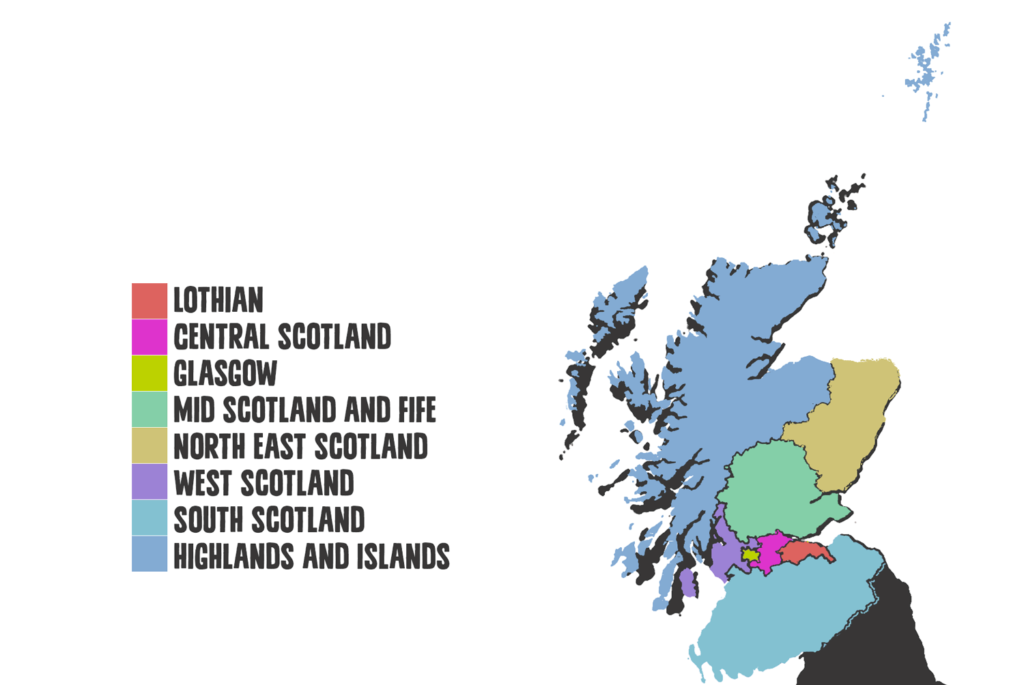
There are eight regions in Scotland, with seven MSPs for each region, giving a total of 56 regional MSPs.

Within thoses eight regions that are 73 constituencies, divided roughly equally across the regions.

So the total number of MSPs is 129 (56+73)

Therefore, everyone in Scotland is represented by eight MSPs – one constituency MSP and seven regional MSPs.

MSPs serve currently for four years, and the last election was in 2011 – hence the election on 5th May. That’s changing and those elected on 5th May will serve for five years to keep in line with European Union terms and the rest of the UK. The idea is that it will help cut costs by not having elections in different years.

At the polling station everyone will be handed two voting slips – a lilac voting slip for the constituency MSP and a peach-coloured voting slip for the regional MSP.

The lilac constituency ballot paper lists the name of each candidate along with their party name and party logo.

The peach regional ballot paper lists the parties and any independent candidates. It does not list the names of the party candidates.

So in essence and leaving independents out of the picture, you vote regionally for a party, and locally for a person.

Constituency candidates are elected on a first-past-the-post system.

Regional votes are counted using the Additional Member System. The system attempts to ensure that it is unlikely that one party will dominate the seats or that any party that gets less than 7% of the vote will get a seat.

A party can list up to 12 regional candidates in each of the 8 electoral regions and could get up to seven members voted in at the election. The remaining people on the list are there to fill in any places that become vacant during the next five years due to death or other cause.

The City of Edinburgh Council has a link where you can download the Lothian Regional party lists for each party.

The Scottish Regions

The Scottish Regions for the election of MSPs

Guilty Men

Guilty Men is a slim book – just 125 pages – written in 1940 by ‘Cato’ – the collective nom de plume of the journalists Michael Foot, Frank Owen, and Peter Howard.

It is an attack on the governments of Baldwin, MacDonald, and Chamberlain of the previous ten years, arguing that they had failed to prepare Britain for an inevitable war and describes how the actions of these governments led to the debacle of Dunkirk.

The book cites Churchill as the man who had consistently warned of the dangers and who was the right man to be in charge of Britain’s future in the war years.

It was a runaway bestseller and the principal author, Michael Foot, went on to become the leader of the Labour Party in Britain.

I bought a copy from a second-hand bookshop after learning of the existence of the book while reading Nehru’s The Discovery of India. I zipped through Guilty Men in a couple of sittings and more or less believed every word of it.

The benefit of 70 years hindsight is pretty good at testing the truth of what was said in the book. I recommend it to anyone who wants to read the story of Britain in the lead up to its darkest hour.

Where The Title Of the Book Came From

The Preface to the book states:

On a spring day in 1793 a crowd of angry men burst their way through the doors of the assembly room where the French Convention was in session. A discomforted figure addressed them from the rostrum. “What do the people desire?” he asked. “The Convention has only their welfare at heart.” The leader of the angry crowd replied. “The people haven’t come here to be given a lot of phrases. They demand a dozen guitly men.”

Who was Cato?

There were several people named Cato in Roman history, but I think the one who fits the best description was Cato the Younger. He is described in Wikipedia as being remembered for his legendary stubbornness and tenacity, as well as his immunity to bribes, his moral integrity, and his famous distaste for the ubiquitous corruption of the period.

Why Russia Has Been Bombing ISIS

Russia has a naval base at Tartus on the Mediterranean coast of Syria. And if the Asad regime goes, so might Russia’s base.

The base is Russia’s only refuelling depot in the Mediterranean. Without it, Russia’s naval vessels would have to refuel and refit on the Black Sea and exit via Turkey, which is of course a member of NATO.

There is of course, Sebastopol – a Russian naval base on the Black Sea. In 2010, Russia and Ukraine ratified a treaty that gave Ukraine access to Russian gas in exchange for an extension of Russia’s lease of the base at Sebastopol through to 2042, with options to extend for further five-year periods beyond that.

Then came the 2014 Ukrainian revolution.

There are differing views of what the Ukrainian revolution was and is about. Is it a country that wants to express its democratic wish to join the West? Is it a country run by gangsters and opportunists banked by Western companies that see opportunities for a new market if Ukraine joins the Western club?

What you think depends on who you read.

Was Russia’s action in annexing Crimea a long-term plan crafted to look like a democratic response to the Ukrainian revolution? Or was it was a reasonable response to a desire by the Russian-population of the Crimea not be dragged away from mother Russia?

Again, what you think depends on who you read.

One thing is clear though and that is that the 2014 Ukrainian revolution put the Russian gas-for-bases treaty at risk. And without Sebastopol, Russia would have to rely on its Black Sea port at Odessa. Sebastapol has a much more equable climate. Odessa is further away from the Mediterranean and it is ice bound in winter.

So putting all this together, Russia is protecting Sebastapol and Tartus. And against that backdrop, and whatever other motivation it might have – its bombing of ISIS is easy to understand.