China And The Sea of Japan

North Korea Russia China border at the Tumen River

The Russia – North Korea border is at the Tumen River that opens into the Sea of Japan. China’s border is at the Friendship Bridge upstream.

The Friendship Bridge connects the Russian town of Khasan with the North Korean town of Tumangang.

To get to the open sea, Chinese goods cross into North Korea by road. Then overland to the port of Rajin further down the coast, a port that was built by the Chinese.

To reach the Sea of Japan by sea, Chinese ships have to leave from Shanghai or Dalian and travel up the strait between South Korea and Japan.

Just this summer Russia proposed that they and North Korea allow China to navigate the Tumen River to the sea.

If that was all that was proposed it wouldn’t make much difference to China. The river is too shallow to allow large ships to pass. And the Friendship bridge is too low.

But the proposal is to dredge the river to allow larger vessels to navigate it, and to demolish the Friendship Bridge. And presumably to rebuild it but higher to allow large ships to pass.

Large ships would include the Chinese Navy. If the project happens it would mean a strategic change in the region.

Iran Strike

I’ve been thinking about the interception of the drones and missiles from Iran. What would have happened or might have happened if America, Britain, France had not stepped in? What might have happened if the Jordanians had not allowed the use of their airspace? Then what might the result have been?

And I’m trying to picture it from the point of view of the Iranians who must have thought that a good number of their drones and missiles would get through. Perhaps they did not expect that the Americans and the French and the British and the Jordanians would all coordinate efforts to stop the rockets and missiles and drones.

And so the question might be what might have led them to think that the Americans, the British and the French would not have it all coordinated and worked out and immediately do what was needed?

And it might be we can link it back to the killing in the aid truck of the food aid workers by Israel in error.

And President Biden’s response, which went from criticism to threat.

My feeling is that President Biden is a politician, by which I mean that he understands people.

He understands when he can say something and then simply jettison it in the face of something else later on.

He understands people and he understands how to give out messages.

I don’t think in all the time of his presidency he’s ever put a foot wrong in terms of giving out messages.

So I wonder whether Iran simply read America wrong.

That is, they assumed that he, President Biden, would be so annoyed with Israel that he, the United States, would not come to Israel’s aid and that therefore Britain and France would not and that therefore Jordan would not. And that that was the miscalculation by the Iranians.

There is a counter-argument that the intention of the Iranians was to draw out the truth of the affiliations of the Americans, British, and French – and perhaps even more specifically of the Jordanians. Unless the ordnance that was directed at Israel is small potatoes for Iran, then it was an expensive gambit.

I can’t see it as a gambit so far as the USA, Britain, or France are concerned. If anything, the news seems to be that the moral outrage of anti Israel protesters is wearing thin with a lot of people. But Jordan – that may be a weak point, although whether the whole of Iran’s gambit turned on this? Maybe.

Nakhchivan Autonomous Republic and Nagorno-Karabakh

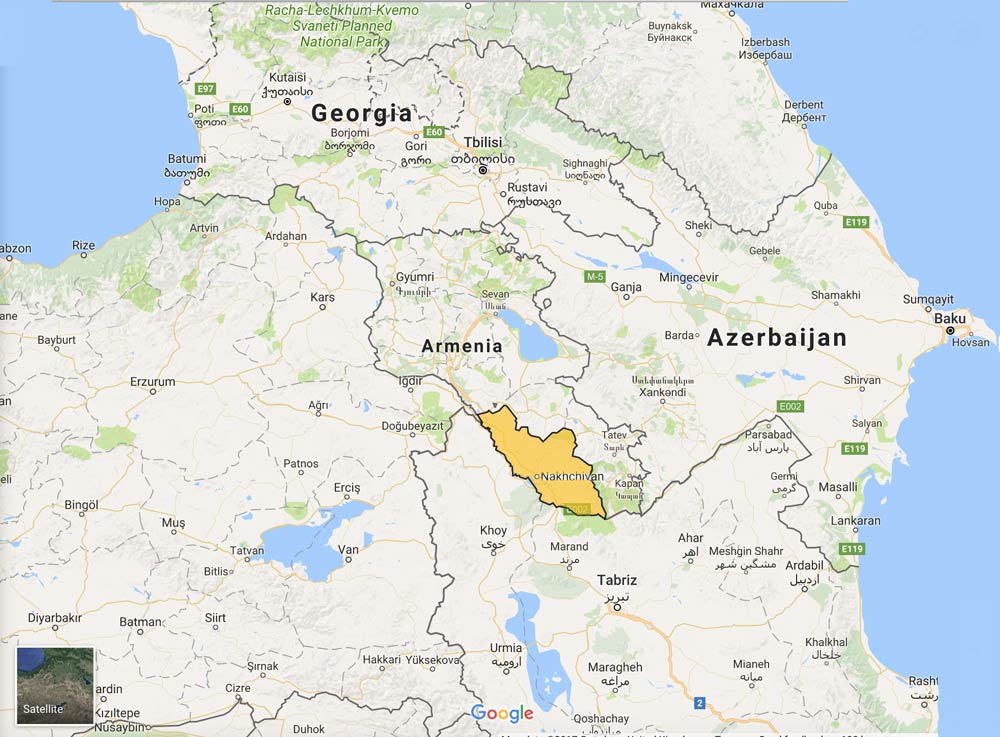
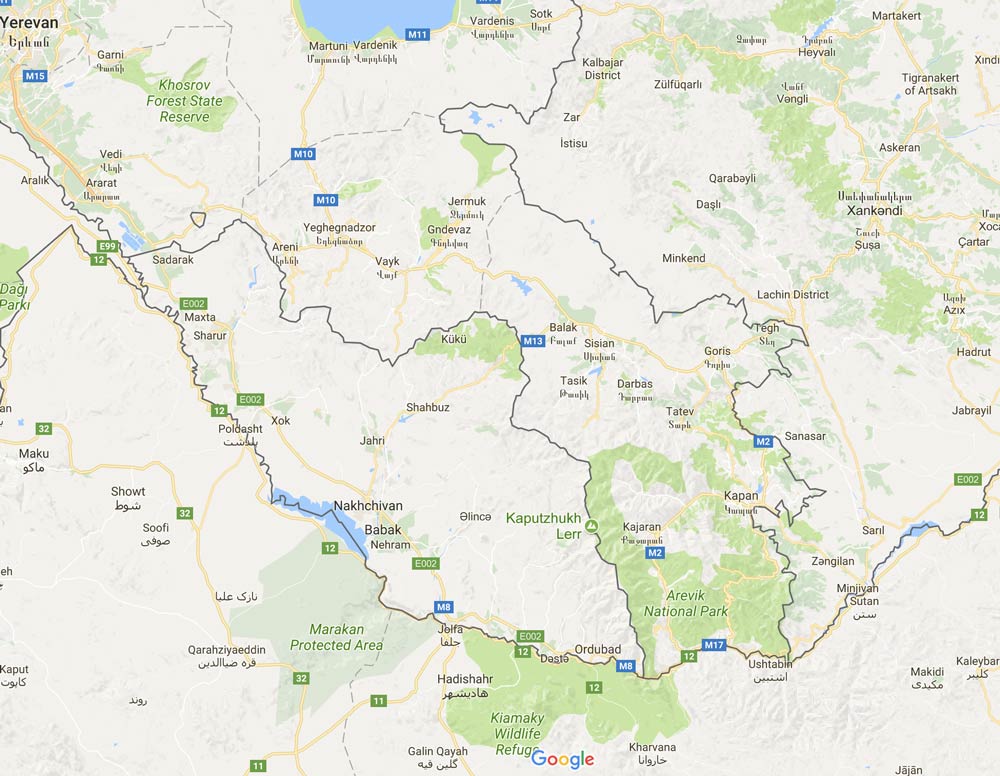
The Nakhchivan Autonomous Republic is an autonomous enclave of Azerbaijan. It is separated from the rest of Azerbaijan and completely surrounded by other countries. It shared a tiny sliver of border with Turkey on the west.

It was formerly owned by what was then Persia (now Iran) and then in the early 1800s after the Russian-Persian war, by Russia.

That changed again with the 1917 Russian revolution when it was contested by Armenia and Azerbaijan.

Fast forward to 1990 when it declared independence from the USSR to show solidarity with the nationalist movement in Azerbaijan, and the following year it declared itself the Nakhchivan Autonomous Republic within the newly independent Republic of Azerbaijan.

That decision to ally with Azerbaijan resulted in conflicts and cross-conflicts with Armenia, Turkey, and Russia – who all had an interest in the region.

Nagorno-Karabakh

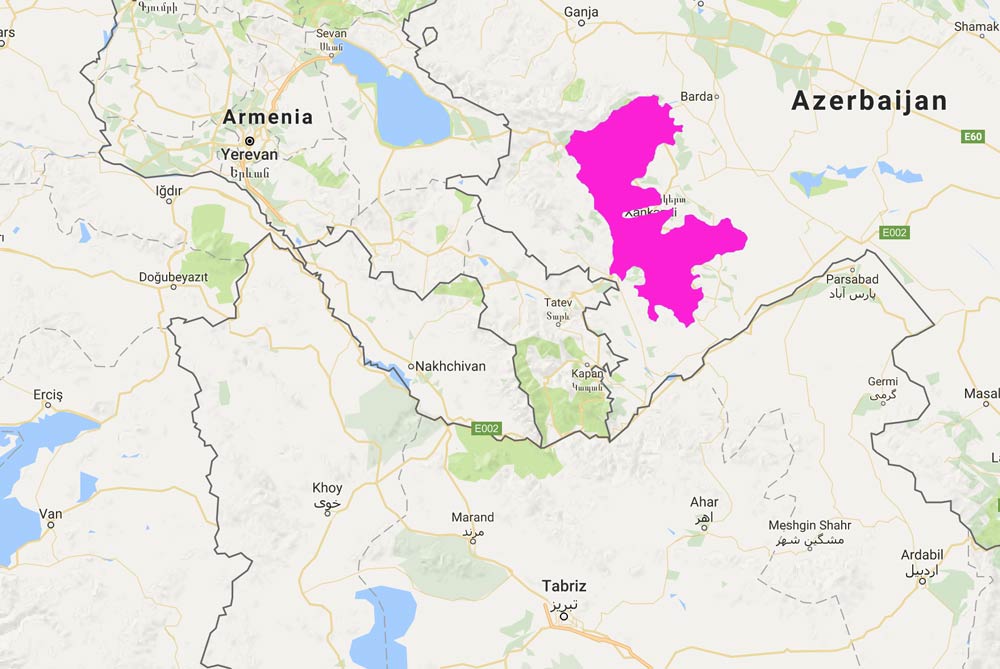
Nagorno-Karabakh is another region close by, internationally recognised as being part of Azerbaijan but run as an independent state by the Armenian ethnic majority. Not being a country, it isn’t marked on most maps and I have coloured it fuchsia on this Google map.

The Lachin Corridor

In a statement to the United Nations on 18 September 2005, the Foreign Minister of Azerbaijan, Elmar Mammadyarov, said “It is the issue of communication of the Armenians living in the Nagorno-Karabakh region of Azerbaijan with Armenia and that of the Azerbaijanis living in the Nakhchivan region of Azerbaijan with the rest of the country. We suggest the using of the so-called Lachin corridor – which should be called “Road of Peace” – by both sides in both directions provided that security of this road will be ensured by the multinational peacekeeping forces at the initial stage”

Update 2022

On 22 Dec, Michael Carpenter of the US Government published a long thread on Twitter. One tweet was a warning about a “A military flare-up in Nagorno-Karabakh if Prime Minister Pashinyan does not cater to corrupt Russian interests in Armenia.”

Update September 2023

The BBC and other news outlets are reporting today about demonstrations that have been taking place in Nagorno-Karabakh’s regional capital Stepanakert. The demonstrators are demanding the reopening of the Lachin Corridor linking the Nagorno-Karabakh to Armenia

For nearly nine months the corridor has been blocked by Azerbaijani authorities, resulting in shortages of food, medication, hygiene products and fuel.

What a mess.

Vichy

In May 1940, Germany invaded France and conquered it in six weeks. Under the peace terms, only the northern half of France was occupied by the Germans. The southern half of France was governed as Vichy France by the French themselves under Marshal Petain.*

The French outside France who didn’t like the Vichy peace terms, maintained a Free French government in exile.

In Syria, the Vichy government’s forces fought and were forced to sign an armistice with the British and Free French in June 1941.

In December 1941 the Japanese attacked the United States at Pearl Harbour, and immediately afterwards Germany and Italy joined with Japan in declaring war on the United States.

Here is the strange thing, Vichy France maintained diplomatic relations with the United States until the Allies invaded French North Africa in November 1942. At that point the United States shut its consulate in Marseille.

So in that eleven month period from December 1941 to November 1942, a citizen of the U.S. could travel more or less freely around southern France. Not only that, the United States had a consulate in Vichy France.

I wonder what happened when German and U.S. citizens in Vichy met during that period. Did they politely nod to one another?

Come to think of it, ‘Casablanca’ – the Humphrey Bogart/Ingrid Bergman film could be just that – an American in Vichy controlled Morocco during that period. Though to be sure it could be set in the period before the U.S. entered the war in December 1941. I guess there may be clues or statements in the film about when it was set. And now reading about the film at filmsite.org I find:

The Hollywood fairy-tale was actually filmed during a time of US ties with Vichy France when President Roosevelt equivocated and vacillated between pro-Vichy or pro-Gaullist support. And it was rushed into general release almost three weeks after the Allied landing at the Axis-occupied, North African city of Casablanca, when Eisenhower’s forces marched into the African city. Due to the military action, Warner Bros. Studios was able to capitalize on the free publicity and the nation’s familiarity with the city’s name when the film opened.

Varian Fry

Varian Fry was an American journalist who was in Germany in 1935 and didn’t like what he saw. When Germany invaded France in 1940, he asked permission of the U.S. State Department to rescue Jews from Vichy France.

In August 1940 he set up a fake business in Marseille, the declared mission of which was to alleviate the plight of refugees by donating food and clothing. Behind this front Fry helped thousands of Jews and a score of ‘undesirable’ artists make the journey overland to Spain and from there to neutral and friendly Portugal.

As time wore on, the U.S. State Department pressured him to get out but he stayed until he was kicked out by the Vichy French Authorities in August 1941, after two years of operations.

It came out after the war that the State Department was actively trying to prevent any Jews reaching the USA and frustrating the efforts of other Departments to help them.

Fry grew up in Ridgewood, New Jersey and there is a permanent exhibition in his honour at the public library, and a street named after him.

Afterward: Marshal Petain

Marshal Petain commanded the French Army in WWI, and at the end of the war he was a hero of France and would have continued on to Berlin to prevent another war, but was overruled.

He changed in the inter-war years and led the establishment of his Government after Germany conquered France in June 1940.

After WWII the war, history decided that the French arrangement with the Germans was too cozy a collaboration to be called a victor-vanquished relationship. Petain was tried for war crimes and sentenced to death, but because of his age his sentence was commuted to life imprisonment and he died in confinement in 1951. Not least among his crimes were ordinances he signed at the request of the Germans that eased the transport of Jews to the camps, and the establishment of collaborationist armed militia that hunted members of the French Resistance.