The English Revolution 1640 by Christopher Hill is available to read online, and that is how I read most of it before I bought the book secondhand. It’s a slim book and an easy read.
What It Argues
The English Revolution 1640 argues that the monarchy, the landed gentry, the church, the merchants, the peasantry, the urban masses, the army all had their positions to protect. But their allegiances were shifting in a changing world.
Merchant capitalists were making money overseas and as pirates on the high seas. Those who bought land following the destruction of the churches under Henry VIII wanted rack rents (rents that represented the full open market annual value of a holding) from their tenants.
They weren’t interested in the feudal relationships that had kept the feudal landlords living like lords. The new breed of landlord didn’t want tenants with their feudal copyhold entitlement to remain on the land. They wanted money.
The term rack rent originated in England in the early 1500s, and meant an extortionate rent, a rent raised to the highest possible limit, a rent greater than any tenant can be expected to pay. It derived from the now obsolete meaning of ‘rack’ – to extort or obtain by rapacity above a fair level.
The towns wanted workers, and tenants wanted to feel safe. They didn’t feel safe from being evicted from their land because they feared being unable to pay rack rents. So they were moving away to the towns to work.
The towns were bound by guilds that prevented the opening up of competition. Acts of Parliament prohibited those less well off from entering guilds.
But things were changing, the makeup of Parliament was changing. And the entrepreneurs knew how to circumvent the King’s parliament by establishing businesses outside the towns, free of the restrictions.
Prices rose, and the feudal order collapsed because it was too expensive to maintain.
Meanwhile, attitudes were changing because the Church was no longer the only route for disseminating truth and propaganda.
Civil War
The result was civil war, the establishment of a republic, and eventually a change in the relationship of parliament to the monarchy. When Charles II was crowned, he understood he did parliament’s bidding and not the other way around.
What didn’t happen? The mass of the population were not able to take power. They tried but they failed.
Economic changes and the march of history rarely favour those trying to stop change.
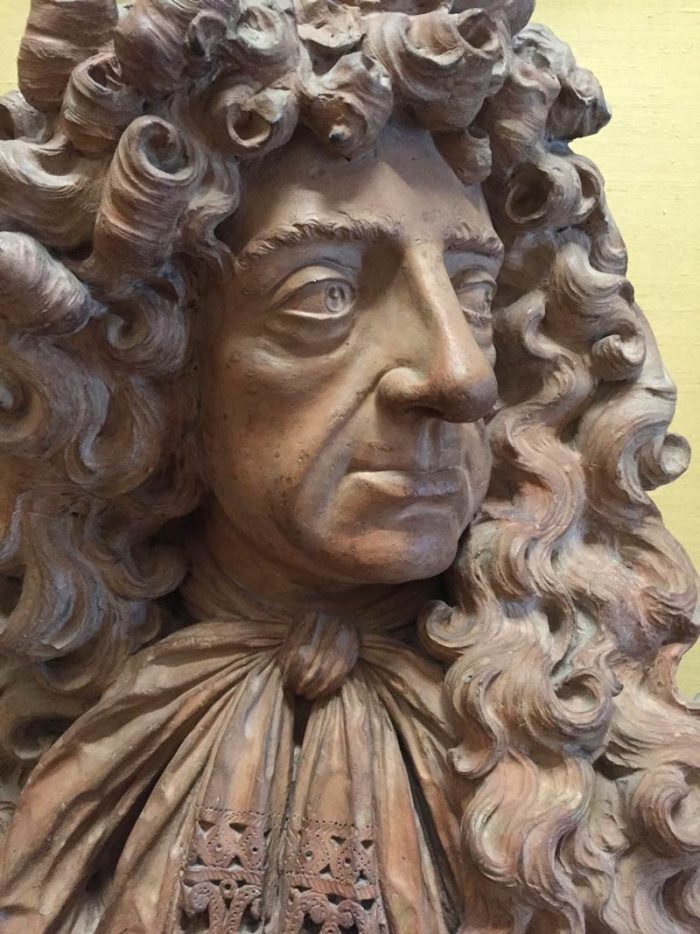
I think the look in the face of Charles II in this c.1678 terracotta bust attributed to John Bushnell says it all. He was brought back on condition that he knew his place and kept out of politics. (The bust is in the Fitzwilliam Museum in Cambridge.)
Quotes From The English Revolution 1640.
The English Revolution of 1640-60 was a great social movement like the French Revolution of 1789. The state power protecting an old order that was essentially feudal was violently overthrown, power passed into the hands of a new class, and so the freer development of capitalism was made possible. The Civil War was a class war, in which the despotism of Charles I was defended by the reactionary forces of the established Church and conservative landlords.
Parliament beat the King because it could appeal to the enthusiastic support of the trading and industrial classes in town and countryside, to the yeomen and progressive gentry, and to wider masses of the population whenever they were able by free discussion to understand what the struggle was really about.
Ever since then orthodox historians have done their utmost to stress the “continuity” of English history, to minimise the revolutionary breaks, to pretend that the “interregnum” (the word itself shows what they are trying to do) was an unfortunate accident, that in 1660 we returned to the old Constitution normally developing, that 1688 merely corrected the aberrations of a deranged King.
Whereas, in fact, the period 1640-60 saw the destruction of one kind of state and the introduction of a new political structure within which capitalism could freely develop. For tactical reasons, the ruling class in 1660 pretended that they were merely restoring the old forms of the Constitution. But they intended by that restoration to give sanctity and social stamp to a new social order. The important thing is that the social order was new and would not have been won without revolution.
A TV Series About The Period
I have now watched a series of BBC programmes with three episodes dedicated to Charles I. It emphasised, firstly, the fear that the Puritans in the Commons had that Charles’ wife, who was French and a Catholic, was turning the king back to Catholicism.
And it emphasised, secondly, that the King was circumventing Parliament by using the Royal Prerogative to tax without the authority of Parliament and to punish without trial. To the Puritans in the Commons, the King was an autocrat who had to be tamed.
The King was not a consensus politician. To him, Parliament was an obstacle he had to ride over to get his way. There was no attempt to bridge the gap and there were many ‘final straws’, but one that stung the most was the King’s attempt to foist a new prayer book in standard form on all subjects.
To the Scots; to the liberal-minded Londoners, and to the Puritans, the King’s prayer book was a Catholic mass by another name.
The Great Remonstrance was a list of complaints about the King’s behaviour, carefully worded so as not to impugn the King himself, for that would be treason. First the Commons voted to put the Great Remonstrance to the King. Then they voted to publicise the Great Remonstrance, with the result that the London was up in arms. Then it was presented as a Bill in Parliament with proposals to change the balance of power between king and Parliament.
Traditionally, the King could count on the Royalists and the bishops in the House of Lords to defeat contentious Bills.
And that’s where plague stepped in to lend a hand to the course of history. Among the Royalists were landowners who lived outside London. And they didn’t want to risk exposure to plague and did not come in the numbers needed. And the bishops were warned off by angry young Londoners. So the Bills passed and the power in the country shifted away from the Crown.
With the King in open opposition to the Puritans, the breakdown in communication ended in the civil war and the abolition of the monarchy.