A Personal Note On The Death Of Queen Elizabeth II

Tamara and I booked to see Much Ado About Nothing, being put on by the National Theatre and beamed to our local Picturehouse cinema. It was Tamara’s idea and I was happy to go along with it. I feared that the comedy would be insubstantial, but in fact it is much weightier than say ‘Taming Of The Shrew’ that we saw recently. And it was well acted and the set design was terrific.

Meanwhile, this afternoon, Queen Elizabeth II died.

Tamara and I were late to arrive at the cinema, and when we walked into Screen 1, everyone was silent, as were the audience at the National Theatre in London who were on the screen. We realised that someone at the London venue had asked for silence to acknowledge the passing of the Queen. Then the National Anthem was played and people in the cinema stood up. Tamara and I were standing already because we had just walked in, and we hadn’t yet gone to our seats.

Then a man at the London venue spoke and said that the show would go on. And we expected the show to begin more or less straight away. But that didn’t happen. Instead the curtain with the words Much Ado About Nothing filled the screen and there was no sound. And it just went on and on. It was eerie, as though it was echoing the breakdown in the smooth flow of things. So we all sat in silence, just watching this curtain remind us that is was Much Ado About Nothing.

I was thinking that after three million years of evolution we still do not know what death is, or at the absolute least one can say there is no consensus about what it is.

And I was thinking of the living. How will the country deal with the event? Britain is faced with the worst civil discontent for a generation. People talk openly about the cost of living crisis. If you know the British you know that they do not talk about money and how tight it is and how bad things are – not in public, between strangers. But they are doing now. It is not taboo. Rather, it has become a part of the public discourse. That’s how bad things are.

Post Office Workers, Royal Mail workers, Rail workers, Legal Aid barristers – they are all staging strikes for better pay and conditions.

We have a new Prime Minister who is there because the last one was kicked out.

The pound is at its lowest value in a generation.

So how will the country react to the death of the Queen? Will it draw people together or will it be one more event that leads to the break in the ties that keep civil society intact?

So here we are in the play, near the end. In a moment Claudio will find out that Hero, his beloved, is not dead and everything will end happily.

Except the link to the National Theatre broke at that moment, and the last we see before the screen goes blank, is Claudio’s hand open, waiting, frozen.

The audience sits, waiting to see whether the link can be restored (it cannot), and there is a strange and patient mood in the air, and behind it all, the death of Queen Elizabeth II.
The Last Prime Minister

I wrote the following in the few minutes before the next British Prime Minister Liz Truss was announced. The election of her to the role by Conservative Party members followed the ejection of Boris Johnson from the job for his unforced errors and disregard for the truth.

An unforced error is a mistake in play that is attributed to one’s own failure rather than to the skill or effort of one’s opponent. And there were several that resulted from Johnson’s disdain for what I believe he saw as petty rules. He was attractive to those who wanted a strong leader precisely because he was a buccaneer, treading where others more timid feared to tread. As in many things, qualities have a good and a bad side.

Prorogration

The first unforced error was that on 28 August 2019, the Parliament of the United Kingdom was ordered to be prorogued by Queen Elizabeth II upon the advice of the Conservative prime minister, Boris Johnson. Britain is a constitutional monarchy, meaning that the reigning monarch has little power, and ‘on the advice of’ is a particularly British way of saying the the prime minister ordered the Queen to prorogue Parliament.

A prorogation is the discontinuance of a session of Parliament without dissolving it. Johnson’s purpose in proroguing Parliament for an unusually extended period was to severely limit the time that the MPs in the House of Commons had to consider the Brexit Bill that was before it. 

Concerned citizens raised a legal challenge and the Supreme Court ruled that the prorogation was unlawful.

Had Johnson’s Government given even the slimmest of reasons for their action, then the Supreme Court would not have looked to the adequacy of the reason. But the Government gave no reason, and that allowed the court to conclude that the reason for such a lengthy discontinuance was simply to deny Parliament time to carry out its function, and that that was unlawful.

The statement by Johnson that I found most telling was when he said later of his accomplishments, “..we saw off Brenda Hale..” Brenda Hale was the president of the Supreme Court. First, he didn’t see off anyone. He was called on his flagrant trashing of the rules of prorogation. Second, it is boorish to call her by her name and not by her honorific. Third, he and she are part of the system of Government that rules this country, and to trash her personally is to prove his disdain for the laws and the system that hold the country together.

Owen Patterson MP

The second unforced error was to try to overturn the 30 day suspension of Owen Patterson MP after Kathryn Stone, the Parliamentary Commissioner for Standards of the House of Commons, found him guilty of breaching the paid advocacy rules.

In October 2021 the Commissioner found that Owen Paterson had breached the paid advocacy rules for making three approaches to the Food Standards Agency and four approaches to the Department for International Development in relation to Randox and seven approaches to the Food Standards Agency relating to Lynn’s Country Foods.

The Commissioner said Paterson had “repeatedly used his privileged position to benefit two companies for whom he was a paid consultant, and that this has brought the house into disrepute” and that “no previous case of paid advocacy has seen so many breaches or such a clear pattern of behaviour in failing to separate private and public interests”.

Acting on her report, The Commons Select Committee on Standards recommended that Paterson be suspended from the Commons for 30 sitting days. The Government decided they didn’t like that and voted to overturn the suspension. The uproar that followed resulted in Own Paterson resigning as an MP.

Malicious Slander

The third unforced error was to maliciously slander the Leader of the Opposition Labour Party in the House of Commons.

Munira Mirza is a British political advisor who was the Director of the Number 10 Policy Unit under prime minister Boris Johnson, until she resigned today, 3 February 2022. She resigned because, as she described in her resignation letter, the Prime Minister Boris Johnson knowingly and maliciously slandered the leader of the Opposition with a false claim about his supposed failings when he was Director of Public Prosecutions.

Christopher Pincher MP

The final straw for the members of his Cabinet was when he promoted Christopher Pincher MP, knowing that Mr Pincher was subject to an investigation over sexual assault, and then lying to Parliament saying he was not aware of the allegations and the investigation.

Partygate

And I have not touched on Partygate and the breaches of the rules about meeting during COVID that his Government has laid down and which the population had followed, sometimes resulting in family members not being there to say goodbye to loved ones on their deathbed.

A Tale Of Two Courts: Roe v Wade and Prorogation

After the reversal of Roe v. Wade, the attorney general in the United States and the President of United States said the decision of the Supreme Court to overturn Roe v. Wade was wrong.

On 28 August 2019, the Parliament of the United Kingdom was ordered to be prorogued by Queen Elizabeth II upon the advice of the Conservative prime minister, Boris Johnson. Britain is a constitutional monarchy, meaning that the reigning monarch has little power, and ‘on the advice of’ is a particularly British way of saying the the prime minister ordered the Queen to prorogue Parliament.

A prorogation is the discontinue a session of Parliament without dissolving it. Johnson’s purpose in proroguing Parliament for an unusually extended period was to severely limit the time that the MPs in the House of Commons had to consider the Brexit Bill that was before it.

Concerned citizens raised a legal challenge and the Supreme Court ruled that the prorogation was unlawful.

Had Johnson’s Government given even the slimmest of reasons for their action, then the Supreme Court would not have looked to the adequacy of the reason. But the Government gave no reason, and that allowed the court to conclude that the reason for such a lengthy discontinuance was simply to deny Parliament time to carry out its function, and that that was unlawful.

Conservatives said the Supreme Court leaned too far to the Left, and was wrong to declare illegal the proroguing of parliament by the Conservative government.

If we start to say that one court is politicised and goes against the will of the people then where does it end?

Of course, some people would say – there are huge differences in the nature of the cases between in the USA and Britain.

Dig deeper, though, and the arguments are the same. The argument in the USA is that the Supreme Court has been packed with ultra-conservative judges with an avowed intention to come to conclusions other than the known general will of the people.

The argument in the UK is that the Supreme Court consists of members who are against the will of the people to ‘deliver Brexit’.

What is the same in both jurisdictions is that one of the foundational pillars of law is being attacked. There are routes to moving past unpopular decisions, but calling the court enemies of the will of the people is a dangerous road. It is a dangerous way to look at things because the will of the people is not a safe route to furthering the best in humanity anyway.

Making A Sand Mandala

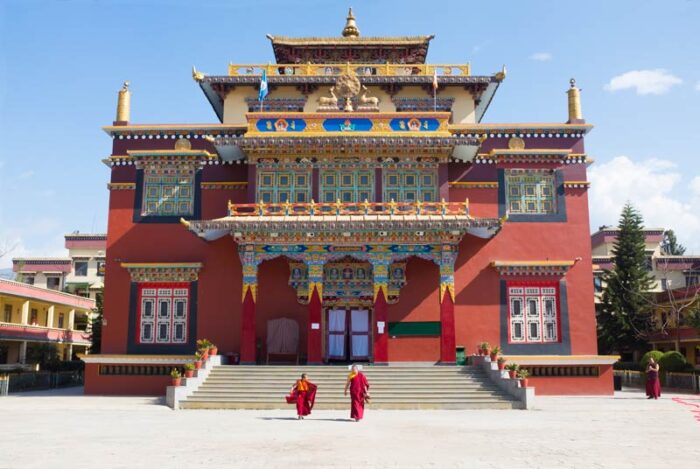
In a Buddhist monastery in Nepal a group of seven or eight young monks were making a sand mandala. The mandala was in three levels, a large base level several feet across; another smaller level raised on support legs; and then a third, smaller level above that. I cannot remember what the bases were made of, perhaps thin sheets of wood or metal. But I remember the process they used to make the pattern on the mandala.

The monks were lying down around the mandala, each working on a part of the pattern. Each monk had a small tool that he used to release fine coloured sand in a precise manner. As they moved their tools along, the monks ‘drew or painted’ the sand on the bases, to make one highly detailed pattern in many colours. Mandalas follow an established pattern, which means that the monks are not designing it from scratch, but rather ‘painting by numbers’ as it were, but in sand.

The tool each of them used to release coloured sand was in two parts – a long, slim conical tube and a rod.

The sand was released from the conical tube, which was about a foot long. The coloured sand was loaded into the wide end, and came out of the narrow end. But the hole at the narrow end was extremely tiny. It was so tiny that a monk could ‘draw’ a fine line if he wanted, as he moved the tube along.

The hole was so tiny that the sand did not fall out of the narrow end of the tube under its own power of gravity. It had to be coaxed out of the tube, and for that the monks used rods several inches long. The conical tubes were smooth on the outside except for one section where the surface was made into small ridges and grooves running at right angles to the length of the tube. Together the ridges made a tiny staircase from the bottom to the top of the tool. The monks rubbed the rods gently back and forth over the ridges, and that coaxed the sand out of the tubes so that they were painting with sand.

Now, having got this far you may be wondering why I am devoting so much time to describing the process. Well, first the process is very painstaking and detailed. It takes effort, concentration, and patience to paint the design in sand and to fill in areas of colour with sand coming out of such a tiny hole in the end of the tube.

It is obvious that it would take days to finish. I can’t really remember the speed at which they were working, but maybe it would take them a week to complete it.

And the monks are working very close to one another and have to be aware of each other’s feet and legs and arms or they risk jerking or crashing into one another or the mandala and upsetting the pattern.

In order to make a sand mandala, the monks have to work together. If there was resentment, pride, superiority, or any sense of inequality in the mind of any one of them, it would set up tension. I think that would translate to the work and could be seen in the quality of the work. Pretty soon there’d be an accident and someone would knock against the design. I am sure the monks were all aware of that.

A mandala represents a truth, and its meaning is bound up in Buddhist teachings. Sand mandalas are ceremoniously thrown away, and that impermanence is essential to the purpose of their creation. So what the monks are working on inevitably brings about contemplation of themselves. The process of creating the mandala builds the ability of the monks to form a brotherly relationship. Someone could look at the building of good relationships as incidental to the creation of the mandala, or they could look at it as the very purpose for which the work was done.

shechen-monastery-in-boudhanath.

.