Photography, Art, and Cultural and Social Inferiority

jo-spence-exhibition

Stills is a photographic centre in Edinburgh. You can develop and print film there, attend courses on photography and design, and see what’s on in the gallery.

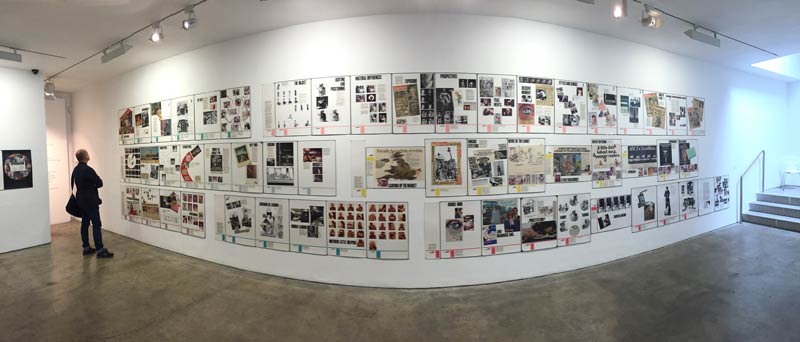
At the moment there is an exhibition of the life and work of the photographer Jo Spence, who was born in London 1934 and died in 1992.

She was merciless on herself and spent a lifetime examining her relationship with her mother and with the way society manages us. When she fell ill with breast cancer she documented what happened and how she was treated by the NHS.

She did phototherapy sessions with other photographers. One would act out a meaningful part of their life and the other would photograph it.

Jo did a series of herself as her mother, with all the aspects of that persona that Jo saw over the years. And she did a series of herself as a bride, and as a child, and as a woman investigating a hoover.

When she was 45 she started a degree course in Film and Photographic Arts at the Central London Polytechnic.

There she and Mary Ann Kennedy, Jane Munro, and Charlotte Pembrey formed a photography group known as the Polysnappers.

Amd their degree show was a series of panels on the subject of the politics of representation. You can see that in the image at the top of this article.

They combined commentary with bits cut out of newspapers and magazines, and the theme was clear: What is acceptable and desirable is pushed at us relentlessly. The task is to decode the message and know who is pushing it.

One panel caught my eye – and it is not directly on the theme of the politicisation of representation, but about photography and art.

There is a quote by Bill Jay that turns on its head some of the arguments about the second-class cinderella that is photography.

There is no doubt that art-photographers in America consider themselves a breed apart – one higher on the evolutionary scale of the medium – than photography in other fields. I remember discussing a set of documentary photographs with a critic and an historian who ended the conversation, to his satisfaction with the remark: ‘But of course they are not art’.

I agreed, which rather took him aback. ‘No’, I said, at their best such photographs are culturally, socially and historically more important than art…’ Why should anyone assume that Art is at the apex of a cultural pyramid and, by extension, anything that is not art is therefore less important?

…Photographers, then, have a cultural and social inferiority complex that is manifested in adolescent belligerency, an egomania that threatens to destroy the medium.

Only If You Like Jazz

There was a programme on TV about the origins of Bosa Nova. As is usual, it was my wife Tamara who found the programme and got me to sit and watch it with her. She is marvellous. Where does she find these programmes?

So part way through the programme the interviewer is talking with a pianist. And there is an intro of a few bars and my ears perked up. The pianist is Cliff Korman and I googled his name. It turns out he is from New York and lives in Brazil.

Here he is playing Manhã de Carnaval with the Brazilian clarinetist Paulo Moura.

It’s less that 10 minutes long – so not too much to listen to if you don’t like jazz. But I am willing to bet that you will like it.

Don’t you just love to find people you want to listen to. It’s strange how one can feel a kinship with them. I don’t know Korman’s politics, for example. And yet I think I probably know how he thinks about things.

I had this discussion with someone years ago. It’s the question of interpretation versus explanation.

When we know something about the person who makes the music or writes the novel or the poem, or makes the film – does it alter the thing they have made?

Is it we who cannot remove ourselves from the narrative we construct as we interpret the piece?

Or is it there, right in the very piece itself and knowing something about the person is part of unfolding the piece?

Running On Empty Money

The country is running on empty.

Forget what you’ve heard about the English classes being defined by culture and leisure-time pursuits.

The classes in England are defined by money.

If it was hidden by a smoke-screen in earlier generations, it is naked now.

The solid middle class might have to pull their belts in a notch in times of economic austerity, but they will be able to sail to safety in the lifeboat of their cash savings. Not that I blame them – let’s be clear. This is just about people surviving as best they can in a fragmented society.

Available cash is what marks the middle class from the lower-middle class below them.

The lower-middle class has the aspirations and some of the jobs, but they don’t have the cash. They exist on borrowed money. Their greatest fear is to lose their house. Their mortgages are what keep them compliant.

I didn’t mention the working class. There isn’t any working class any more. As soon as the Margaret Thatcher’s ‘Right To Buy’ scheme gave Council tenants the right to buy their rented property, the working class disappeared. They are now the lower-middle class.

Well of course there are true working class people – people with nothing to protect and only their labour to give. But they don’t constitute a class now because they are too marginalised even to recognise one another.

Mark Carney On Bank Stress Tests

Shortly after the EU Referendum vote the Governor of the Bank of England, Mark Carney, sat on a panel and explained the stress tests that British banks were dealing with in the aftermath of Brexit. I listened to the whole thing – an hour of it.

If you want to listen to it, it’s on the Bank Of England website under Publications/Financial Stability

He said the banks are able to deal with twice as much stress as they faced in the days following Brexit. And they can deal with any future shocks.

A bit previous, as you might say, is what I thought. Let’s see what the situation is in six months or a year. Brett might be a slow burn.

He also said that banks needed to make credit available.

And now I have just read the August paper from the National Institute of Economic and Social Research. It starts with a quote about the blues from Gil Scott-Heron, so it can’t be all bad.

It concludes that these are risky times, but financial markets worldwide continue to have an appetite for holding UK debt. And it says that banks need to make credit available.

As I said, we have a pseudo-middle class living on borrowed money. Mark Carney didn’t argue when one of the audience asked what he meant about banks extending credit given that the ratio of average debt to available income in the UK is 132%.

And if the average is 132%, think how high it must be for some people.

That can’t go on forever. I mean, seriously, how can it just trundle on?

And if you are in the ‘poor’ sector of the population, how can you even think about getting credit from a high-street source?

Mortgage Relief On Buy-To-Let Properties

Did you see how the Government took away the tax relief on mortgages on buy-to-let properties? That’s going to put the squeeze on those landlords who can only make their sums work when they get that relief.

They will have to sell the properties, and then those with real free cash will buy up the properties. Meanwhile, slowly but surely, those who bought their Council houses will lose their properties and the gap between the rich and the poor will widen yet more.

It really is the Enclosure Acts for the twenty-first Century.

Meanwhile the new Prime Minister talks about making this a society that is fairer and includes us all. Well I shouldn’t bitch before I see how it plays out, but I have my doubts.

My Take On This

You know the story of Nero fiddling while Rome burned? Well it seems to me that the one thing that is not taken into account in these bank stress tests is when the pips start speaking for enough people to do more than just complain.

I really shouldn’t go on about this much more, because remember that we (the UK, that is) voted for the Conservatives a second time after complaining for five years that they were terrible.

We railed against their inhumanity. We asked how they could tip invalids out on the street and deny them benefits. We said it was an attack on the three pillars of the Welfare State – health, education, and housing.

And then we (the UK, that is) voted for them again.

And what did we learn? We learned that when push came to shove, we voted for ‘I’m alright Jack and let someone else suffer.’ And all that complaining was just hot air.

So maybe Britain is genuinely immune from any action to adjust society to a fairer, more inclusive version.

United By Faith and Informed By Science

My wife pointed out that Theresa May is the daughter of a vicar and Angela Merkel is the daughter of a theologian. What insights they must have into each other – something that not a lot of other politicians can share.

And did you know that Angela Merkel was a research scientist before going into politics. She holds a Doctor of Natural Sciences for her thesis on quantum chemistry, and worked as a researcher and published several papers.

I am a sucker for education.

What Happened When I Learned To Concentrate

Someone asked me the secret to concentration. I don’t claim to have it, but I remember when I learned to concentrate.

It happened when I was nearly thirty years old. Yes, I had been through school, university and a post-graduate course, and still I didn’t know how to concentrate.

Then one day it all changed.

I was in the college library studying for an exam. I had my books and notes around me. Something clicked inside of me and I felt in command. I felt like Captain Picard on the Starship Enterprise.

What I mean is that my physical relationship to the papers around me changed. I sat up alert in my chair. I was in charge. I looked around at the papers, the notes and the books and saw them as connected rather than separate. They told a story together – no longer were they separate sources.

Maybe what happened was a lucky chance. Maybe it was because the papers and books were spread in a semi-circle. Maybe that is what made them seem like the dials on a starship, or a car or an aeroplane.

For whatever reason, it was simply easy for a moment to be aware of my physical and mental relationship to the material.

I realised in that moment that up until then in my mind I had always been hanging on by my fingertips – convinced I would fail or at least not do very well.

Up until then I had managed, but that was such a poor substitute for succeeding.

I had managed but I had always felt I was standing on a quaking volcano of uncertainty.

Now I was in command.

I didn’t suddenly become brighter or more able to do things – but I could concentrate. I was relaxed. And because I was relaxed, I could take things in, see the connections.

I already knew that being relaxed made studying easier. What I learned was that my relaxed state came out of my feeling of being in command.

And why shouldn’t I feel in command? If I feel anything else it undermines the endeavour from the beginning and I sabotage myself.

Of course, we humans are notorious for doing that, aren’t we?