Over A Million Barrels Of Oil In A Rusting Hulk In The Red Sea Since 1988

Remember the Exxon Valdez that ruptured when it hit a reef off the coast of Alaska?

The oil tanker owned by the Exxon Shipping Company, spilled 11 million gallons of crude oil into Alaska’s Prince William Sound on March 24, 1989.

It caused the world’s biggest maritime environmental disaster.

In terms of volume of oil released it is second to the Deepwater Horizon spill in the Gulf of Mexico, but in terms of damage it is the worst by far. Despite a clean-up that went on for years, less than 10% of the oil was recovered.

Now fast forward to today, and just so we are sure we are comparing apples with apples, that was 11 million gallons of crude oil that leaked out of the Exxon Valdez.

In the oil industry, a barrel is defined as 42 US gallons, or 35 imperial gallons.

Well, the Floating Storage And Offloading Vessel Safer (yes, that’s its name) has 1.2 million barrels of crude oil in its tanks. That’s 50.4 million US gallons of oil, or more than four times the amount on the Exxon Valdez.

The FSO Safer lies 15° 07.0′ N, 042° 36.0′ E at the Ras Isa Marine Terminal (YERAI) and it has been there since 1988, rusting and abandoned.

And since 2015 a pawn in a game of chicken between Iranian-back Houthi rebels and just about everyone else.

The Houthis want payment for the oil. The UN wants to avoid an ecological disaster.

Here is a general map of the region, with the FSO Safer marked with a red dot, and again in the close-up map.

Apart from the ecological damage at stake, to the south is the narrow Bab-El-Mandeb Strait (‘The Gate of Lamentations’ in Arabic) that gives out into the Gulf of Aden. Via the Suez Canal it is the shortest trade route between the Mediterranean, the Indian Ocean, and the rest of East Asia. So not surprisingly it is one of the world’s major trade routes.

So how is this going to play out? The Houthis agreed to let UN inspectors in, and then changed their minds. And meanwhile the hulk rusts.

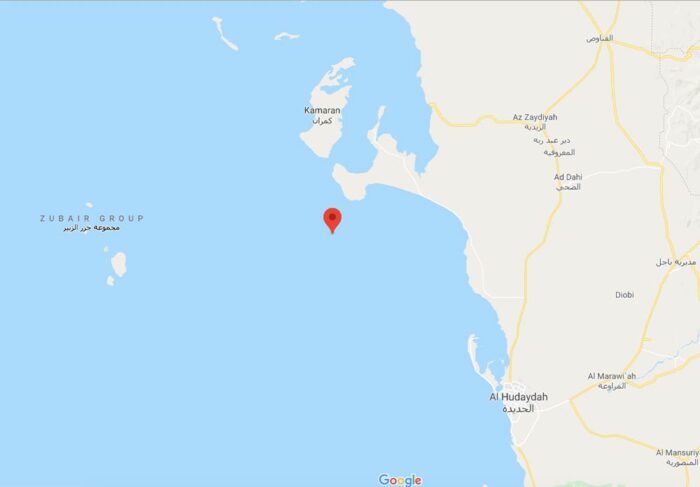
A general map of the region of the Horn of Africa, with the SFO Safer marked with a red dot.

A close-upl map 15° 07.0′ N, 042° 36.0′ E at the Ras Isa Marine Terminal (YERAI), with the SFO Safer marked with a red dot.

Update 16 August

The Saudi newspaper Asharq Al-Aswat reported on 16th August on a seminar held by The Yemen Coalition of Independent Women. One item caught my eye, which is the claim that Iranian-backed Houthi militias are smuggling of Thorium from Yemen to Iran.

Update 18 August

Sea News reports that the IMO (an agency of the United Nations responsible for regulating shipping) is putting a plan in place to try to make the SFO Safer safe or to deal with a leak if there is one. I don’t know whether that is any advance on the news we have already, but one thing that caught my eye is that there are “recent reports of water entering the engine room”. 

April 2022

It reads like a bad dream. How could this be going on for so long. The Security Council Report for April reads:

There has been progress towards resolving the threat posed by the FSO Safer, the vessel moored off the Houthi-held port of Ras Issa in the Red Sea that is at risk of a major oil spill or explosion. On 5 March, the UN signed a memorandum of understanding with the Houthis and the Fahem Group (one of Yemen’s largest import companies) to transfer the oil on the Safer to a vessel that would replace the ageing tanker. The memorandum notes that the plan is contingent on donor funding and could entail an interim ship to hold the oil until a suitable replacement vessel for the Safer is acquired.

Feudalism For The Twenty-First Century

Originally posted 4 December 2019 on ‘Marginal Seat’ (a site I have now redirected)

In the UK the Conservatives under Margaret Thatcher introduced a Right To Buy for tenants of Local Authorities. Tenants could buy their Council houses at a discount reflecting the years they had spent paying rent.

Property prices rose in the years following, and at the same time the Government loosened the regulations around who could borrow on credit and for what purpose.

When tenants (now property owners) fell into credit card debt, the way out was simple – buy another property or remortgage with a larger loan.

When property prices fell and people lost their homes, people with more borrowing power bought them up to rent them out, assisted by tax incentives on mortgage repayments.

After some years the Government removed the tax relief on ‘Buy To Let’ mortgages, with the result that those properties were snapped up by people with even more borrowing power or by still richer people with cash, looking for somewhere to invest.

An article from 2017 in the Guardian, under the title ‘Four in 10 right-to-buy homes are now owned by private landlords’ referred to Freedom Of Information requests sent by Inside Housing to local councils in England. A 2015 article from Inside Housing reported that the responses from 91 councils “show they have sold a combined 127,763 council flats and maisonettes since the Right to Buy was introduced in 1980. Among these, 47,994 leaseholders are registered as living away from the property a strong suggestion that they are renting it out privately. This means 37.6% of the council homes which were sold off at a discount in the hope of fulfilling a homeownership dream, are now back in the rental sector. Just for much higher rents.”

The result of forty years of Government policy has been to widen the gap between the haves and the have nots – and create a new feudal class for the 21st century.

In short, the arc of progress has been to bring to fruition the intended consequences of a long-term plan masquerading as unintended consequences.

Beware the apparent unintended consequences of Government policies that are in fact the fruition of a carefully laid out plan.

Update 8 December 2019

Article by Adam Williams in the Telegraph on 7 December 2019

Buy-to-let landlords plan to leave the market in huge numbers next year as new analysis suggests that more than 100,000 rental homes have been sold since a punishing tax regime was introduced.

Investors have faced stringent restrictions since April 2017, when the Government started to limit the amount of mortgage interest and other costs that could be offset against tax. In some instances landlords face a marginal tax rate of more than 100pc.

These new rules are being phased in until 2021, but thousands of landlords have already decided to throw in the towel. Analysis of mortgage transaction data by Savills, an estate agency, shows that 103,900 more buy-to-let homes have been sold than bought since the new tax regime was introduced.

Tales From The Anteroom

The scene is the anteroom before souls are injected into the worlds. Present are the voyager and the guide. The guide is explaining the scene that lies before them.

Outside the window there are vast celestial bodies. They arrange and rearrange themselves so that one celestial body is central and the others rotate about it. Each celestial body is identified in turn by the guide.

“This is the fucking body; this is the acquisitive body; this is the higher plane body. You choose which celestial body most appeals to you and that is the world where you live. That is the world where you will experience what is central in your mind and your desires. The other bodies will rotate about it but it will be central and the world you experience will be dominated by what you desire.

As you can see, the bodies have arranged themselves based upon the karma you carry from past lives. It appears you want (words muffled as the guide turns away) and so it shall be if you want.

There is time to change your mind but remember that if you choose that which you do not really want, you will have an uncomfortable time down there.

On the other hand, choose what you want wisely. There are roads that lead out of here and roads that lead back to this anteroom.”

Apple And The EU General Court Judgement Today

On Monday 5 September 2016 I noticed a link in the bottom right-hand corner of the home page of Apple’s UK site.

It wa entitled, ‘A Message to the Apple Community in Europe’, and it was in response to a fine levied by The European Commission at the instance of the EU competition commissioner, Margrethe Vestager.

This is the text of Tim Cook’s message, which I copied at the time because who knows how long it would remain available.

Tim Cook’s Message

August 30, 2016 A Message to the Apple Community in Europe 
Thirty-six years ago, long before introducing iPhone, iPod or even the Mac, Steve Jobs established Apple’s first operations in Europe. At the time, the company knew that in order to serve customers in Europe, it would need a base there. So, in October 1980, Apple opened a factory in Cork, Ireland with 60 employees.

At the time, Cork was suffering from high unemployment and extremely low economic investment. But Apple’s leaders saw a community rich with talent, and one they believed could accommodate growth if the company was fortunate enough to succeed.

We have operated continuously in Cork ever since, even through periods of uncertainty about our own business, and today we employ nearly 6,000 people across Ireland. The vast majority are still in Cork — including some of the very first employees — now performing a wide variety of functions as part of Apple’s global footprint. Countless multinational companies followed Apple by investing in Cork, and today the local economy is stronger than ever.

Steve Jobs visits Apple’s new facility in Cork, October 1980. The success which has propelled Apple’s growth in Cork comes from innovative products that delight our customers. It has helped create and sustain more than 1.5 million jobs across Europe — jobs at Apple, jobs for hundreds of thousands of creative app developers who thrive on the App Store, and jobs with manufacturers and other suppliers. Countless small and medium-size companies depend on Apple, and we are proud to support them.

As responsible corporate citizens, we are also proud of our contributions to local economies across Europe, and to communities everywhere. As our business has grown over the years, we have become the largest taxpayer in Ireland, the largest taxpayer in the United States, and the largest taxpayer in the world.

Over the years, we received guidance from Irish tax authorities on how to comply correctly with Irish tax law — the same kind of guidance available to any company doing business there. In Ireland and in every country where we operate, Apple follows the law and we pay all the taxes we owe.

The European Commission has launched an effort to rewrite Apple’s history in Europe, ignore Ireland’s tax laws and upend the international tax system in the process. The opinion issued on August 30th alleges that Ireland gave Apple a special deal on our taxes. This claim has no basis in fact or in law. We never asked for, nor did we receive, any special deals. We now find ourselves in the unusual position of being ordered to retroactively pay additional taxes to a government that says we don’t owe them any more than we’ve already paid.

The Commission’s move is unprecedented and it has serious, wide-reaching implications. It is effectively proposing to replace Irish tax laws with a view of what the Commission thinks the law should have been. This would strike a devastating blow to the sovereignty of EU member states over their own tax matters, and to the principle of certainty of law in Europe. Ireland has said they plan to appeal the Commission’s ruling and Apple will do the same. We are confident that the Commission’s order will be reversed.

At its root, the Commission’s case is not about how much Apple pays in taxes. It is about which government collects the money.

Taxes for multinational companies are complex, yet a fundamental principle is recognized around the world: A company’s profits should be taxed in the country where the value is created. Apple, Ireland and the United States all agree on this principle.

In Apple’s case, nearly all of our research and development takes place in California, so the vast majority of our profits are taxed in the United States. European companies doing business in the U.S. are taxed according to the same principle. But the Commission is now calling to retroactively change those rules.

Beyond the obvious targeting of Apple, the most profound and harmful effect of this ruling will be on investment and job creation in Europe. Using the Commission’s theory, every company in Ireland and across Europe is suddenly at risk of being subjected to taxes under laws that never existed.

Apple has long supported international tax reform with the objectives of simplicity and clarity. We believe these changes should come about through the proper legislative process, in which proposals are discussed among the leaders and citizens of the affected countries. And as with any new laws, they should be applied going forward — not retroactively.

We are committed to Ireland and we plan to continue investing there, growing and serving our customers with the same level of passion and commitment. We firmly believe that the facts and the established legal principles upon which the EU was founded will ultimately prevail.

Breaking That Down

  • The message is addressed to the Apple Community, and by making a public statement it is telling the EC it is not going to back down and it is confident it is right.
  • Apple has been in Ireland for a long time – thirty-six years, in fact.
  • Apple is an important player in Ireland, with 6,000 employees.
  • Apple is an important player in Europe, in the USA, in the world.
  • The principle is that countries are taxed where they create value. Apple’s R&D is in the USA and that is where the value is created and that is where the tax should be paid.
  • The EC wants to retroactively remake the tax laws for Ireland and internationally.
  • This will adversely affect many companies, not just Apple.
  • If the EU wants to change its tax laws, it should do so by legislative change and this should be applied going forward and not retroactively.
  • A warning that if the EC does change the tax laws even going forward, remember what is set out in the preceding points and realise that Europe will be the loser.

EU Court Decision Today

Now fast forward to today, 15 July 2020 when the European Union’s general court has ruled that Apple does not have to pay the thirteen billion euros fine because the Commission had failed to proved that Apple had benefited from an allegedly illegal arrangement with the Irish authorities.

So that is €13bn that Apple can take out of its provision and add back into its general pot.