Crown Copyright Restrictions

Virgin Money made a bid for Northern Rock in 2008, and in 2011 it got the go-ahead from the British government to buy the defunct bank.

Tamara and I were in London on the day that Northern Rock’s demise was being debated in the House Of Commons. Tamara had been invited to tea at the the House of Lords earlier that day, and I went to collect her.

We decided to walk down the corridor and watch the proceedings in the House of Commons. We stood in line and went through endless corridors to eventually find ourselves in the Visitors’ Gallery looking down on the Speaker and the assembled MPs.

It couldn’t have been better timing because, the House was at that very time debating the proposed takeover of Northern Rock.

The chamber was packed and the two sides of the House were arguing bitterly over whose fault it was that the bank had collapsed. Was it due to easy credit, poor regulation, bad tax incentives, sky-high commissions?

We watched the debate for a long while, looking through the new plexiglass screens along all sides of the chamber that separated the visitors from the MPs below.

Northern Rock’s Background

Northern Rock was a bank. It started out life as a Building Society, and its lending policy was governed by the Building Societies Acts, which meant it could only lend money against mortgages on property and that it had to follow the strict rules applicable to building societies.

Changes In Legislation: From A Building Society To A Bank

Northern Rock became a bank in the 1990s when, owing to changes in legislation, many other building societies were taking the opportunity to do the same. The advantages were that as a bank it could invest and also borrow more widely.

Unfortunately, the new latitude led to its becoming the first bank in 150 years of British banking to suffer a run on its assets. Trading between banks, is conducted on a short cycle. The borrower borrows for six months and must then repay unless a new borrowing cycle is agreed. Bigger banks decided they didn’t want to lend on Northern Rock’s lending portfolio and the Bank of England having to step in.

Northern Rock had of course bet on an international portfolio that was caught in the 2008 financial crash. It had gone out to play with the big boys and it had been caught short.

For the UK, the run on Northern Rock’s assets carried the risk of a total default, so the British government bought the bank.

Northern Rock wasn’t the only bank to fail. For whatever reason, the Government bailed out the Royal Bank of Scotland and LloydsTSB Bank, but it let Northern Rock go to the wall. Perhaps it wasn’t too big to fail, to quote the US authorities who rescued the biggest US banks.

Crown Copyright

As Tamara and I lined up to go into the visitors’ gallery of the House of Commons we were each handed a thin A4-size booklet that contained a copy of the day’s proceedings.

I would show you a photograph of the booklet, but it is Crown copyright. What that means is that I would need a licence to copy it.

Growing up in England, I was aware that Crown copyright protected all kinds of things from being copied to the detriment of the publishers – namely the Crown, the courts, Parliament, Her Majesty’s Stationery Office, and other similar institutions.

An American Perspective On Government Copyright

At least that was how I looked at it until I read Heather Brooke’s book The Revolution Will Be Digitised: Dispatches From The Information War.

Heather Brooke is an American who at the time was living in Britain. It was she who blew open the MPs’ expenses scandal.

In the book, which is mostly about Wikileaks and whistleblowers, she explains what Crown copyright is from her perspective, contrasting copyright in the United States and in Britain.

Originating with a principle laid down by Thomas Jefferson, all documents originating with the American government belong to the people.

That is why all Americans are free to copy, for example, Dorothea Lange’s world-famous photographs of poverty during the Great Depression.

In Britain the situation is different. And as Heather Brooke puts it, Crown copyright means that citizens have to ask their government for permission to use public data.

She found this out first hand when she made repeated requests for information about MPs’ expenses under the new Freedom Of Information Act and found that public bodies placed copyright notices on their responses.

Her view is that copyrighting of public information in Britain is specifically used as a means of restricting the flow of public information.

They Try To Work For You

As an example of what that means, in 2004 Parliament demanded that the They Work For You website shut down because it published details of how MPs had voted on matters in the House of Commons.

The information is published in the official records of Parliament known as Hansard, and Hansard is owned by Parliament and not by the people. So copying information from it is protected by Crown copyright.

In the end, Parliament was itself backed into a corner and was forced to grant a licence to They Work For You because the idea of suing a website for making such information available to the public was embarrassing to it.

One could say that democracy prevailed, but the reality is that TheyWorkForYou survived because it accepted that it needed a licence, and the Crown Copyright system sails on into the future.


Originally published November 17th, 2011
Existence and Being

Follow-up to a lecture given by Henrik Schøneberg ‘Awakening of Consciousness’. He described Sartre’s theory of existentialism – that existence precedes essence. That is, that it is only by acting, by making choices, that we give meaning to our lives. But if we bumble along without making conscious choices, then we do not realise our purpose and we do not become.

It’s a point of view. I can see how Sartre might see himself as exhorting people to wake up and realise that they must make themselves, not follow the web of established thinking. But does he accept that he too might be wrong, that the truth might lie outside his own thinking?

Heidegger

Schøneberg talked about Heidegger as being the most analytic of the existentialists, but that he ‘went too far’ when he joined the nazi party. As the song goes in Springtime For Hitler, in Mel Brooks’ The Producers, the way to get ahead is to get smart. In the words of the song: ‘Don’t be stupid, be a smarty/Come and join the Nazi Party’.

The philosopher, Heidegger says, is resolved ‘to understand time in terms of time,’ and not time in relation to eternity. He does not want to be involved with the Divine. Religion is an agent of modernity, and Heidegger hated modernity.

Modernity

Modernity is, he says, the process by which powerful movements based on illusion rather than reality, seek to make a paradise on Earth by running people’s lives. I cannot understand at all how Heidegger does not see the nazi party as a prime example, but he sees nazism as going back to the roots of German Being, with a capital B. It is the cure for his existential homesickness.

I kind of get it, it’s visceral and basic and beast-like, and powerful. It’s before all the ‘fancy ideas’, all the fancy rational thinking that screws us up because we think we are rational when in reality we exist before that. It gets your blood up and it makes you feel good, so it must be real.

Well, yes, maybe. That’s the appeal, but in reality the nazi were all scared witless of the guys higher up on the ladder. You can tell from the cut of their uniforms and the swagger. Humility will take you anywhere, but swagger will only get you so far.

Voegelin

Moving on, I came across an article that compared and contrasted Heidegger and Eric Voegelin. Voegelin says it is ‘ridiculous to pretend that there was nothing to consciousness but the consciousness of objects of the external world.’

Well that is either self deception, metaphysics that take one further from Being as Being as meant by Heidegger and Sartre, or else Voegelin is right. Maybe.

On the one hand we have Heidegger’s ‘Being without concepts’. On the other hand we have Voegelin and humility and a sense of awe at the mere existence of existence. And why wouldn’t one want to enquire as to the ‘why’ of existence? Why is it only right to start from existence and work forward? Why wouldn’t one want to search for meaning outside of desires and passions? Voegelin asks whether man can perfect the world without God, and he answers that it is not possible and one shouldn’t try. And that is kind of like Heidegger’s opinion of modernity, so to that extent they can agree.

Man’s Search For Meaning

Does man become divorced from himself by searching for meaning? Is that it? I can see that, too, because we humans are pattern makers above all. We detect patterns, sometimes even where there are none. So we can lead ourselves up the garden path and lose ourselves in metaphysics and lose the simple truth of setting ourselves free to Become. Maybe.

I looked up Heidegger’s personal life. His Wikipedia entry describes he personal life this way:

Heidegger married Elfride Petri in 1917. Their first son, Jörg, was born in 1919. Elfride then gave birth to Hermann in 1920. Heidegger knew that he was not Hermann’s biological father but raised him as his son. Hermann’s biological father, who became godfather to his son, was family friend and doctor Friedel Caesar.

Heidegger had a long romantic relationship with Hannah Arendt and a steamy affair (over many decades) with Elisabeth Blochmann, both students of his. Arendt was Jewish, and Blochmann had one Jewish parent, making them subject to severe persecution by the Nazi authorities. He helped Blochmann emigrate from Germany before the start of World War II and resumed contact with both of them after the war.Heidegger’s letters to his wife contain information about several other affairs of his.

Voegelin, on the other hand, married and as far as I can see, had neither affairs nor divorces. I can cut all this philosophising down to size and say that Heidegger was drawn to go downwards to the brute essence, looking outward like an animal because that is what he was attracted to. Voegelin had a different temperament and looked for the Divine in the everyday. Maybe it was just a difference of temperament.

Existence and Being What?

Thinking back about Sartre, I guess what he does is make the break between existence and being. He thinks it is not automatic that one thinks and chooses and becomes because one exists. He does not say ‘I am and therefore I think. He says I exist and I had better get my skates on and start understanding my situation before it is too late. OK, but where to go from there? To follow one’s passions? To follow one’s desires? On what are those passions founded? What happens when the passion dries up? Is passion enough?

What happens when one’s passions run up against the opposing passions of others? It all seems very lone wolf, like Hesse’s Steppenwolf.

Freud

Freud would say that ego is made whole and balanced and sane when expressed in the community of people. It cannot be made alone. If that is right, then it stands opposed to existentialism, which in Freud’s view would simply be narcissism. That is unless of course through a happy coincidence of passions, the existential person chooses to join the community of people and gain expression there. In the view of Sartre, Heidegger, and Freud it would work just as long as the community of people steer clear of metaphysics and ideologies.

That leaves me with a question. Is there even the beginning of a scale by which to measure the value of such a community? Or is the notion of ‘value’ a descent already into metaphysics and the loss of Being?

Inertia

In Euripides’ The Bacchae, the characters identified as ‘some maidens’ ask and answer the question of what is wisdom:

What else is wisdom? To stand from fear set free: To stand and wait.

In Fyodor Dostoevsky’s Notes from the Underground, the narrator asks and answers what the normal state is for a man who is conscious enough to question the nature of things:

After all, the direct, legitimate, immediate fruit of consciousness is inertia.

I am going to pull back a bit. I am not convinced that the next step from existence is anything active at all. Perhaps it is simply to react. It’s a thought I have had before. I have been down this road. What determines how one puts one foot in front of the other?

If it is habit then it is a terrible thing. If it is curiosity and wonder, then that’s the antithesis of boredom. Perhaps that is enough. Then there is no grand enquiry into ‘Who am I?’ There is instead an appreciation of the rhythm of the day.

In Camus’ The Outsider’, when the principal character shoots the man on the beach he says of himself:

’I knew in that moment that I had broken the balance of the day.’

Is that enough, simply to appreciate? Must we accept that we are discontented with that state, that it is not enough, or that it simply does not apply to us? Are we so deep into metaphysics that we cannot regain that Eden? It’s a problem, and not one I am going to solve today.

Project 100,000

There’s a scene in the film Full Metal Jacket where a raw recruit joins the platoon and is instructed not to leave the path. He is of limited ability and unable to follow instructions. No sooner does he join the platoon than he leaves the path and is skewered in a Vietcong man trap.

In Apocalypse Now there’s a scene where the young soldier, hardly able to follow any orders, wasted on dope, starts shooting wildly. He is out of control, as much a terrified observer as an active combatant.

And in Forrest Gump the hero joins the army and miraculously manages to survive and do well despite being odd and below average in IQ. The way things work out well for him are fantastical. That’s a device used repeatedly in the film.

The war in Full Metal Jacket, Apocalypse Now, and Forrest Gump is the Vietnam War.

You might wonder how men of below average IQ ever got into the army. I knew that people from poor backgrounds, disproportionately black, were most likely to be drafted, but I didn’t wonder at all beyond that. I just watched the films.

Hamilton Gregory

But today I watched a talk by Hamilton Gregory, a man who volunteered for service in Vietnam. He was a college graduate, so he could well have avoided the draft. Many middle class young men did. They didn’t have to try hard; there were exemptions of which they could take advantage.

But Mr Gregory volunteered and as chance would have it, he was ordered to escort another recruit to Fort Benning in Georgia. That recruit was educationally subnormal. He didn’t know that America was at war. He didn’t know in which state he had been born.

Hundreds of thousands of men like him were drafted under Robert McNamara’s Project 100,000. That was the project under which young men of poor IQ were inducted each year.

Robert McNamara

Robert McNamara was the U.S. Secretary of Defence, so it was his call. The army couldn’t get people to go to Vietnam, So McNamara lowered the IQ requirement. He said that the army was one of the world’s best educators, and it could raise the IQs of the draftees. So people who were previously unfit to server were now fit.

In battle they were too slow to react, too slow to understand what was going on, two slow to formulate a plan. They were poor marksmen, erratic and a danger to themselves and their fellow soldiers. And they died in Vietnam at three times the rate other soldiers were killed.

Unofficially, the soldiers in McNamara’s Project 100,000 were called McNamara’s Morons.

Hamilton Gregory was so appalled by Project 100,000 that after the war he gathered evidence and wrote McNamara’s Folly: The Use Of Low IQ Troops In The Vietnam War. And that is what he was talking about in the video I watched.

So now I wonder whether the makers of Full Metal Jacket, Apocalypse Now, and Forrest Gump knew about Project 100,000 and whether they were making a reference to it?

Escape In The Mind

I didn’t really like Forrest Gump that much. I know there was some homegrown wisdom peeking out of that character, some humanity that would not be denied. But I wasn’t fond of the fantastical element because I knew that being saved and prospering is not what generally happens to people like Forrest Gump.

Sure, it has to happen by random chance to someone, even to a person with limited abilities. But still, it seemed like a cop-out, a way of making the audience think that things are good, when in truth they are not.

Reality

In contrast, there’s the film Brazil. It’s fantastical in that the world depicted in the film is odd, odd like in a Kafka novel, but yet near enough for us to be able to recognise it. Life could be like that with just a bit of a shift sideways.

There are the scenes in Brazil where a ninja appears out of nowhere to save the main character. He does so repeatedly. He sweeps in just when things look bad. But in the final scenes, in the end we see that these rescues were an illusion, an attempt by the main character to escape mentally from the horror of torture.

Brazil is depressing. The baddies win and there is no redemption. It’s 1984 in film. But I can live with that more easily than being fed a diet of heroism from characters that were three times more likely to die in war than their fellow soldiers.

The Grand Ethiopian Renaissance Dam

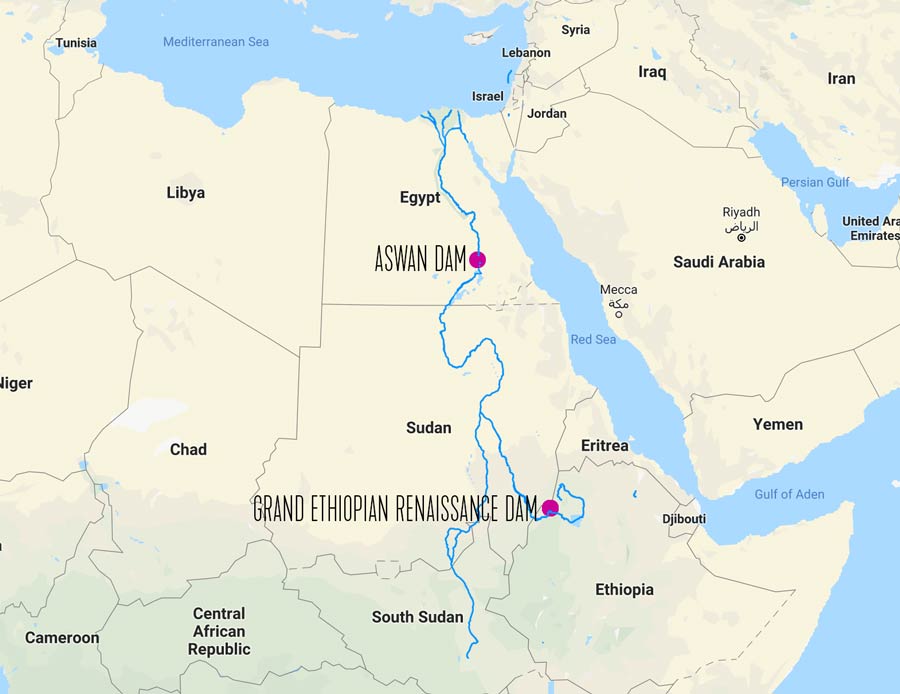
The Grand Ethiopian Renaissance Dam in Ethiopia is nearing completion. Egypt wants a say in how quickly the dam fills and how much is released and when.

It is easy to see why Egypt would want that control. Egypt has a dam of its own. The Aswan Dam in Egypt, completed in 1970, enables Egypt to even out the water that reaches the land in the Nile Delta. But the Nile in Egypt is downstream, so it doesn’t matter how efficiently the Aswan Dam is managed if not enough water reaches it.

In a word, if Ethiopia holds back on the water it allows down the Nile, It will damage Egypt’s fortunes.

Ethiopia has accused Egypt of hydrological colonialism for trying to control how Ethiopia manages the flow from its new dam.

Egypt says that water that flows through more than one country is an international resource. As such, it must be governed by all the concerned parties.

Electricity

As well as controlling water for agriculture, the turbines powered by the dam’s water outflow will provide electrical power for Ethiopia.

And Ethiopia plans to sell the excess electricity generated to neighbouring countries. The power lines are already going in.

But it is not just Ethiopia, Egypt and water. There may be another player in the game.

Who Financed The Grand Ethiopian Renaissance Dam

Ethiopia funded the dam by issuing bonds to nationals in Ethiopia and Ethiopians abroad. It said is was forced to take that route because Egypt pressured international funders to refuse to back the project.

What is not clear is who financed the turbines. The turbines are a big part of the project and the most technical. They are Chinese built, but who paid for them? China?

There’s a statement in Wikpedia, but no source given:

the turbines and associated electrical equipment of the hydropower plants costing about US$1.8 billion are reportedly financed by Chinese banks“.

If that statement is true, then it’s perhaps another example of external finance leading to control when the debtor country cannot repay the debt.

China has been accused of it before. And it is, of course, not the only country accused of that.

So maybe it is a race that Ethiopia has to run. It has to increase agricultural production. It has to encourage new projects within the country that consume that electricity. And it has to make money from selling electricity to neighbouring countries.

And to do so while keeping up payments for the turbines.

Last week, Ethiopian Prime Minister Abiy Ahmed was awarded the Nobel Peace Prize.

map showing the location of the aswan dam and the grand ethiopian renaissance dam