The English Revolution 1640

The English Revolution 1640 by Christopher Hill is available to read online, and that is how I read most of it before I bought the book secondhand. It’s a slim book and an easy read.

What It Argues

The English Revolution 1640 argues that the monarchy, the landed gentry, the church, the merchants, the peasantry, the urban masses, the army all had their positions to protect. But their allegiances were shifting in a changing world.

Merchant capitalists were making money overseas and as pirates on the high seas. Those who bought land following the destruction of the churches under Henry VIII wanted rack rents (rents that represented the full open market annual value of a holding) from their tenants.

They weren’t interested in the feudal relationships that had kept the feudal landlords living like lords. The new breed of landlord didn’t want tenants with their feudal copyhold entitlement to remain on the land. They wanted money.

The term rack rent originated in England in the early 1500s, and meant an extortionate rent, a rent raised to the highest possible limit, a rent greater than any tenant can be expected to pay. It derived from the now obsolete meaning of ‘rack’ – to extort or obtain by rapacity above a fair level.

The towns wanted workers, and tenants wanted to feel safe. They didn’t feel safe from being evicted from their land because they feared being unable to pay rack rents. So they were moving away to the towns to work.

The towns were bound by guilds that prevented the opening up of competition. Acts of Parliament prohibited those less well off from entering guilds.

But things were changing, the makeup of Parliament was changing. And the entrepreneurs knew how to circumvent the King’s parliament by establishing businesses outside the towns, free of the restrictions.

Prices rose, and the feudal order collapsed because it was too expensive to maintain.

Meanwhile, attitudes were changing because the Church was no longer the only route for disseminating truth and propaganda.

Civil War

The result was civil war, the establishment of a republic, and eventually a change in the relationship of parliament to the monarchy. When Charles II was crowned, he understood he did parliament’s bidding and not the other way around.

What didn’t happen? The mass of the population were not able to take power. They tried but they failed.

Economic changes and the march of history rarely favour those trying to stop change.

I think the look in the face of Charles II in this c.1678 terracotta bust attributed to John Bushnell says it all. He was brought back on condition that he knew his place and kept out of politics. (The bust is in the Fitzwilliam Museum in Cambridge.)
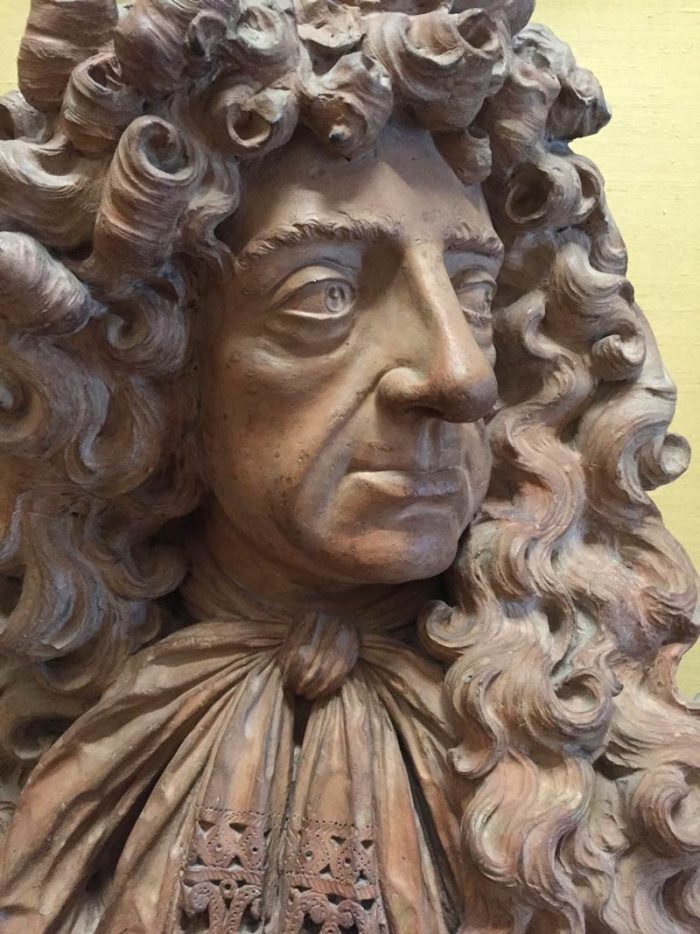
Bust of Charles II, Fitzwilliam Museum, Cambridge

Quotes From The English Revolution 1640.

The English Revolution of 1640-60 was a great social movement like the French Revolution of 1789. The state power protecting an old order that was essentially feudal was violently overthrown, power passed into the hands of a new class, and so the freer development of capitalism was made possible. The Civil War was a class war, in which the despotism of Charles I was defended by the reactionary forces of the established Church and conservative landlords.

Parliament beat the King because it could appeal to the enthusiastic support of the trading and industrial classes in town and countryside, to the yeomen and progressive gentry, and to wider masses of the population whenever they were able by free discussion to understand what the struggle was really about.

Ever since then orthodox historians have done their utmost to stress the “continuity” of English history, to minimise the revolutionary breaks, to pretend that the “interregnum” (the word itself shows what they are trying to do) was an unfortunate accident, that in 1660 we returned to the old Constitution normally developing, that 1688 merely corrected the aberrations of a deranged King.

Whereas, in fact, the period 1640-60 saw the destruction of one kind of state and the introduction of a new political structure within which capitalism could freely develop. For tactical reasons, the ruling class in 1660 pretended that they were merely restoring the old forms of the Constitution. But they intended by that restoration to give sanctity and social stamp to a new social order. The important thing is that the social order was new and would not have been won without revolution.

A TV Series About The Period

I have now watched a series of BBC programmes with three episodes dedicated to Charles I. It emphasised, firstly, the fear that the Puritans in the Commons had that Charles’ wife, who was French and a Catholic, was turning the king back to Catholicism.

And it emphasised, secondly, that the King was circumventing Parliament by using the Royal Prerogative to tax without the authority of Parliament and to punish without trial. To the Puritans in the Commons, the King was an autocrat who had to be tamed.

The King was not a consensus politician. To him, Parliament was an obstacle he had to ride over to get his way. There was no attempt to bridge the gap and there were many ‘final straws’, but one that stung the most was the King’s attempt to foist a new prayer book in standard form on all subjects.

To the Scots; to the liberal-minded Londoners, and to the Puritans, the King’s prayer book was a Catholic mass by another name.

The Great Remonstrance was a list of complaints about the King’s behaviour, carefully worded so as not to impugn the King himself, for that would be treason. First the Commons voted to put the Great Remonstrance to the King. Then they voted to publicise the Great Remonstrance, with the result that the London was up in arms. Then it was presented as a Bill in Parliament with proposals to change the balance of power between king and Parliament.

Traditionally, the King could count on the Royalists and the bishops in the House of Lords to defeat contentious Bills.

And that’s where plague stepped in to lend a hand to the course of history. Among the Royalists were landowners who lived outside London. And they didn’t want to risk exposure to plague and did not come in the numbers needed. And the bishops were warned off by angry young Londoners. So the Bills passed and the power in the country shifted away from the Crown.

With the King in open opposition to the Puritans, the breakdown in communication ended in the civil war and the abolition of the monarchy.
St Anthony’s Fire

I’ll tell you a story about ergot. In my spare time at university I read a book (The Day of St. Anthony’s Fire by John Grant Fuller Jr) about the 1951 Pont-Saint-Esprit ergot poisoning.

Ergot contains a mass of compounds, some of which act like LSD and some of which have other effects on the body.

There have been reports throughout history of mass poisoning with ergot.

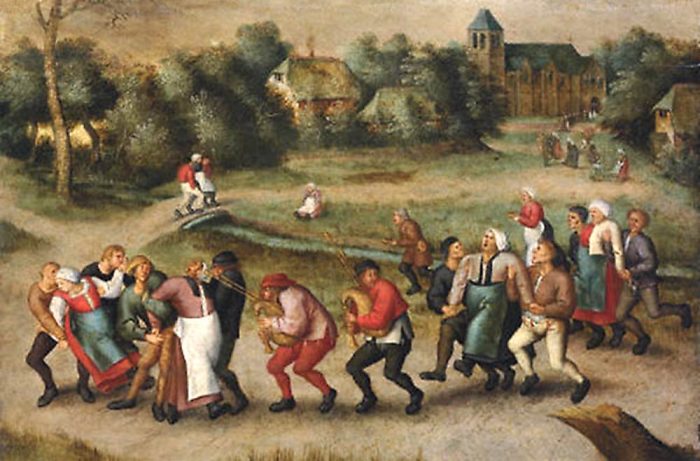
A 2016 article in the Smithsonian refers to an incidence of St John’s dance (another name for St. Anthony’s Fire) that affected a village in Aachen in 1374 where the villagers danced endlessly and uncontrollably.

Breugel painted the annual procession of people affected by St John’s Dance on their pilgrimage to be cured at the church at Molenbeek.

St John’s Dance, or St. Anthony’s Fire, are thought to be incidences of ergotism. 

Hundreds of people were affected in the 1951 outbreak at Pont-Saint-Esprit in France. Some died, some had gangrenous limbs, some went crazy, and some survived intact.

I remember a sentence near the end of the book where one of the outsiders who came to the village after the outbreak described the villagers as moving together like a flock of geese.

That’s got a science fiction sound to it – that the villagers were somehow telepathically tied to one another.  Or perhaps they were simply shocked and came together as survivors of a mutual tragedy.

You may wonder how an incident like this could go on for days and weeks in the 20th century without the outside world quickly arriving to intervene and help people.

This was an isolated village in rural France in 1951, not long after the Second World War. It happened. 

Ergot

A friend and I used to cycle from the university to a nature reserve.

One summer’s day we stopped on a small country road and sat back on the grass by a field. I started to tell her about The Day of St. Anthony’s Fire, the book I was reading, and while I was telling her I saw that there was rye growing around the edges of the field.

It may have been the previous year’s crop that had hung on and sprouted again. Or it may have been there for years, stubbornly refusing to disappear.

I reached back behind my head to take an ear of rye to explain how ergot – Claviceps purpurea fungus – grew inside and over the ear of rye.

I looked at what I had picked and one of the ears was a large, dark purple, curved mass of ergot.

We looked for other ears similarly infected with the fungus. Nothing. Never found another one.

I kept the ear in a small quill box. I had bought in a junk shop because it was similar to the one my parents had at home which I liked.

My dad brought that box back from Japan after he was invalided out during the Korean War.

The box was hand made, black wood with porcupine quill inlays.

I don’t know what happened to the ear of ergot or the box I bought. After my parents died, I kept their quill box, which I still have.


Russia’s Foreign Policy?

On 22 Dec, Michael Carpenter @mikercarpenterSenior Director @PennBiden. Former DASD for Russia/Balkans/Eurasia @DeptofDefense, Foreign Policy Advisor @JoeBiden, and Director for Russia @NSC44 published a long thread on Twitter.

I have no way of knowing what axe he may have to grind in this world where everything is hostage to misinformation, but I want to record what he tweeted – and we shall see how things play out. Here is what he tweeted:

1 A military incursion into Ukraine. The most likely target is the canal that feeds fresh water from the Dnieper river to Crimea. Without this water, Crimea’s agricultural sector goes under. Also look for Russia to seek complete dominance over the Sea of Azov and Kerch Strait.

2 A military flare-up in Nagorno-Karabakh if Prime Minister Pashinyan does not cater to corrupt Russian interests in Armenia.

3 Pressure on President Lukashenka to allow Russia to build a military base in Belarus, especially if the US green-lights the construction of “Fort Trump” in Poland. If Minsk resists, the Kremlin will be prepared to execute an Anschluss operation.

4 Russia and Iran take control of eastern Syria as the US withdraws and Turkey engages in cross-border attacks on Kurdish fighters. Over time this guarantees that disenfranchised Sunni Arabs radicalize into ISIS 2.0.

5 A growing Russian military presence in Libya helps General Haftar consolidate control of the country, which becomes a Russian protectorate.

6 Moscow arms the Taliban with more sophisticated weapons as the US draws down its forces and the NATO ISAF mission is stretched to the breaking point. Moscow displaces the US as the chief power-broker in Afghanistan and the Taliban comes back to power.

7 Moscow supports Bosnian President Milorad Dodik’s efforts to separate Republika Srpska from the rest of Bosnia and Herzegovina, risking a renewed ethnic conflict in the Balkans.

8 The Russian-Saudi relationship blossoms as Moscow sends more weapons to Saudi Arabia and coordinates further oil supply cuts.

9 EU sanctions on Russia fall apart as one of the EU member states breaks consensus in return for an undisclosed energy deal with Russia. The most likely candidates: Hungary, Italy, Austria.

10 The Kremlin’s active measures campaign in the US goes into overdrive as Russia seeks to shape the 2020 presidential field. Dark money becomes the main tool of Kremlin influence as Russia concludes that financing organic disinformation is more effective than offshore ops.

The Whole World In A Grain Of Rice

The opening lines of Auguries of Innocence by William Blake read as follows.

To see a World in a Grain of Sand
And a Heaven in a Wild Flower
Hold Infinity in the palm of your hand
And Eternity in an hour

The connection with ‘a grain of sand’ in Blake’s poem is a bit of a stretch. But the very smallness of a grain of anything brought to mind how Bloomberg published an article on October 4th. In it they claim that the Chinese government snuck a chip the size of a grain of rice onto the motherboards of servers built by the company Super Micro.

The ‘infected’ motherboards were sent to foreign customers including 30 US companies, some of which had US government contracts. The report refers to a major bank (not named) and to Apple and Amazon as being unwitting recipients of the boards.

Apple and Amazon have denied it. Bloomberg is a reputable news source. You would think they would not be given to make up a story ‘whole cloth’ as it were, without any evidence at all. So what is the truth of it?

Then, on 30th October Bloomberg published a short article in which it reported that Super Micro had said they had found no malicious software in its products.

It also reported that the U.S. Department of Homeland Security had said it has “no reason to doubt” Amazon and Apple’s denials of Bloomberg’s reporting.

So why do I feel that this story of auguries of innocence has a long way to run? Perhaps it will take years for the story to unfold.

Auguries of Innocence

The word ‘augur’, as you probably very well know, is an omen of what is to come. It can be for good or for bad. The poem Auguries of Innocence by William Blake, describes how the cruelties of man done against the animal life of the world does not augur well for human beings.

Update October 2020

On October 9, 2018, Bloomberg issued a second report, alleging that Supermicro-manufactured datacenter servers of a U.S. telecom firm had been compromised by a hardware implant on an Ethernet connector. The report cited Yossi Appleboum, former Israel intelligence officer and co founder of cyber security company Sepio Systems. He was said to have documented implants on various companies’ boards. How widespread is the problem, if it exists at all?