Fortress Europe

Fortress Europe.: It may not seem like it sometimes, but compared to life outside fortress Europe, it is heaven. It is heaven at least in terms of the daily grind.

Don’t make light of other people’s troubles. Of course I don’t. But I live in the privileged world.

Of course the modern world brought in the death of community and the birth of ennui. That’s what we are told. When we are far from the harsher realities of life, we risk sinking into meaninglessness.

Every day we balance our feelings and find our equilibrium between the haves and the have nots.

I don’t want to pretend to myself that I am the humblest of creatures who would share his last crust with a stranger.

Actually, I would. It would be easier. To be down to my last crust would make it an easier decision. Then there would be almost nothing to hold on to.

The better question would be whether I would give up a lot of what I have to share, not with one stranger but many, many strangers? Because that is what is happening. People are clamouring at the gates of fortress Europe and fortress North America. They risk their lives to cross the sea to reach their dream. And we inside have to deal with feeling guilty and resentful.

We in the UK give huge amounts of charity to people abroad. When RedNoseDay comes around and the TV presenters ask for money, we give – millions. My wife gives – she gives a lot.

Why don’t we collectively share our last crust and give half of everything we have to those beyond the fence.

But we don’t. And we don’t all say – come, come, share – what is mine is yours.

Tell me I am wrong – tell me that if a vote was taken tomorrow that people would open the gates.
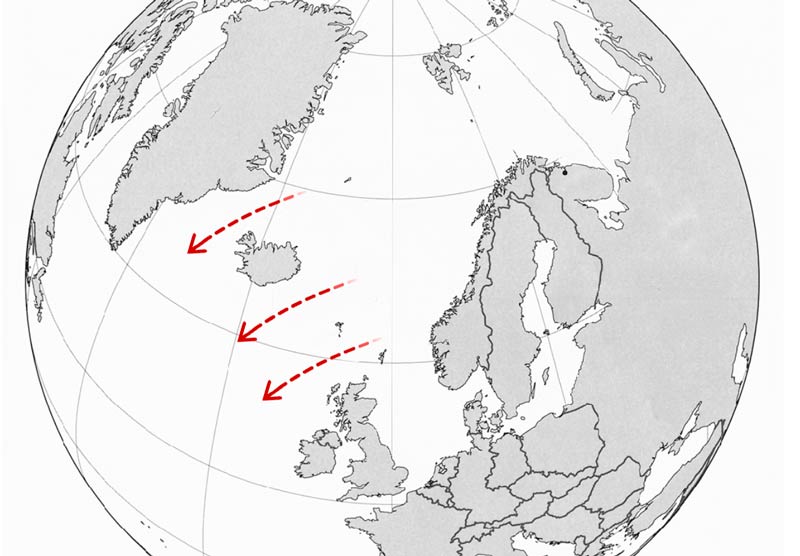
The GIUK GAP

map of the GIUK Gap (the Greenland, Iceland, UK naval choke point)

The GIUK Gap is an abbreviation for the Greenland, Iceland, UK gap.

It’s a naval choke point, difficult for a navy to get past if there are defenders set against it.

What would likely happen in a conflict between Russia and the West?

In a war, the primary task of the Russian fleet in the Atlantic would be to stop the US fleet coming to the aid of Europe.

If the Russian navy wants to get into the Atlantic, it has two choices.

The Black Sea Route

One is to get the Black Sea fleet out of Black Sea, through the Bosphorus, and into the Mediterranean.

Russia has a naval base at Tartus in Syria, so if the Black Sea fleet could get there, it would be able to refuel for the trip along the Mediterranean and into the Atlantic. But that scenario is threatened by the fall of Asad.

Who knows who is going to be friends with whom in the new Syria.

But backing up a bit, Russia’s invasion and annexation of Crimea makes sense because it gives Russia a warm-water port free from ice in winter in the north of the Black Sea.

But supposing Russia negotiates the Bosphorus and gets out into the Mediterranean, it has to face the narrow strait at Gibralter which is covered by the British.

The Murmansk Run

The other option is for the Russian Northern fleet to come down from Murmansk, past Norway, and into the Atlantic.

That’s where the GIUK Gap comes in.

Submarines have got the obvious advantage of not being able to hide, and the deeper they can go the better chance they have of evading detection.

Look at this bathymetric map of the GIUK gap from the Department of Mathematics at Oslo University. It shows how comparatively shallow the gap is between Scotland and Iceland.

That lessens the chance of a Russian submarine being able to sneak past on its way to The Atlantic.

The Russian fleet could skirt around to the west of Iceland and run the gap between Iceland and Greenland. It is a longer journey but it takes the fleet further away from the British area of influence.

And while the gap is still not that deep, it is deeper than to the east of Iceland, if the Russian fleet were take this western route.

The US Navy has taken into account the possibility that Russia would choose to take the Greenland route.

Its 2017 Navy plan includes upgrading its port at Keflavík on the west coast of Iceland. That decision to upgrade the base came about as a result of board games that the US Navy and its allies carried out the year before.

Update 2024-26

So now Trump is upping the ante because if the USA has Greenland then it commands the entire route that Russia could take to get into the Atlantic.

Sixty Million Tonnes Of Wheat

In an article about the pending trade war between the USA and everybody else, the writer mentioned the sixty million tonnes of wheat that the fields of Kansas produce.

I looked up the density of wheat seeds: It’s 0.79

So that tonnage of wheat would occupy 76 million cubic metres. (60m/0.79)

Let’s spread that out two metres deep. Two metres makes sense to me; it’s just fifteen centimetres (six inches) over my head.

Now we’ve got an area of 38 million square metres, two metres deep. That’s 6,000 metres square.

That’s six kilometres.

All that wheat would occupy a space two metres deep in a square six kilometres down each side.

Or in yards and miles, that’s two-and-a-bit yards deep and nearly four miles square.

A lot of wheat.

Amazon Work Safety

I read in the Guardian that Amazon has been accused of treating its staff like robots. There are some numbers in the article: 566,000 employees, 600 times an ambulance has been called out to warehouses in the past three years., 200 union members who say they suffered pain as a result of their workload.

Let’s assume that the number of employees was the same for each of the past three years and that the number of ambulance callouts was evenly spread over the period. That’s 200 callouts per years for 566,000 employees, or one callout per year for every 2,830 employees.

Is that a lot? Is it out of line with other similar firms? What similar firms are there, in fact? Marks & Spencer, Debenhams, the Post Office?

And what were the ambulances called out for? Were they all work-related accidents? Did some people fall ill for reasons unrelated to their jobs?

Without context the figures are meaningless other than to persuade me emotionally that there is something wrong at Amazon. I am not an apologist for Amazon, but this ‘news’ needs context.

Here’s some context from the article.

A Freedom of Information request to ambulance services from the GMB union revealed 115 call-outs to Amazon’s site in Rugeley, near Birmingham, including three relating to pregnancy or maternity problems and three for major trauma.

There were also two call-outs to the site for electric shocks and eight for people who had fallen unconscious. At least 1,800 people work year-round at the Rugeley warehouse and more than 2,000 more can work over the peak Christmas period.

That compares to only eight calls in total to a nearby Tesco warehouse of a similar physical size and where about 1,300 people work, over the same period, according to another FOI request by the union.

Amazon said it was “simply not correct to suggest that we have unsafe working conditions based on this data or on unsubstantiated anecdotes. Requests for ambulance services at our fulfilment centres are predominantly associated with personal health events and are not work related. Nevertheless, ambulance visits at our UK fulfilment centres last year was 0.00001 per worked hour, which is dramatically low.”

A spokesman said that, according to the Health and Safety Executive’s method of reporting injuries, Amazon had 43% fewer injuries on average than other companies conducting transportation and warehousing activities in the UK.

This article is trying to persuade me emotionally that there is something wrong at Amazon. I am not an apologist for Amazon, but without more context this ‘news’ looks more like a hatchet job.